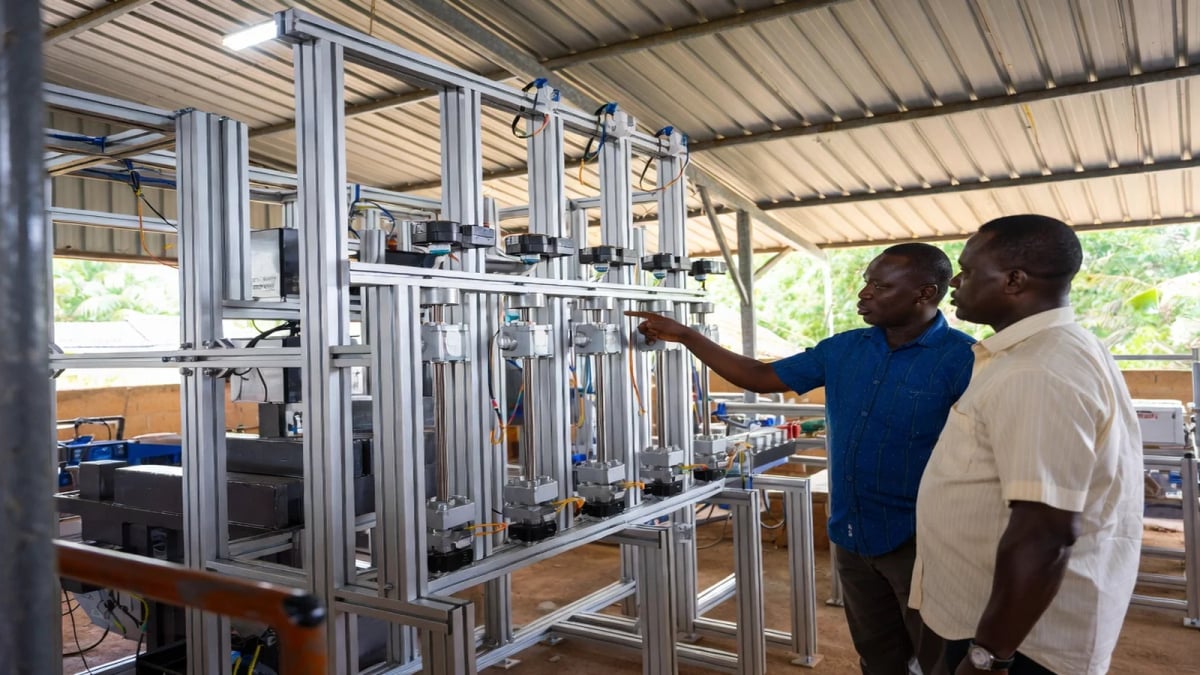
Custom automation solution for an agro-processing facility
An agro-processing facility required a bespoke automation solution adapted to its product characteristics and site conditions. The Project Office engineered a custom system, integrated it into existing workflows and delivered on-site operator training.
Project Profile
Sector: Agro-processing — cereal milling and packaging Scope: End-to-end automation design, systems integration, operator training and commissioning support Geography: Accra industrial corridor, Ghana Delivery Model: Phased implementation across three operational stages
A mid-scale agro-processing facility operating within the Accra industrial corridor engaged RoboFactory Africa to re-engineer its production floor from a predominantly manual workflow into a structured, integrated automation environment. The facility handled cereal grain intake, milling, blending and retail packaging — processes that had historically relied on manual labour at nearly every stage, creating inconsistency in throughput, output quality and shift-to-shift operational reliability.
Specification Challenge
The project presented a compound engineering challenge. The facility operated on a constrained floor layout built for manual workflow — not for the spatial and electrical demands of an integrated automation system. Existing infrastructure lacked the power distribution architecture to support coordinated machine operation. Dust ingress from milling stages posed a real risk to control systems if panel and sensor placement was not engineered with process awareness.
Beyond the physical environment, the facility’s workforce had no prior exposure to PLC-based systems, HMI interfaces or automated conveyor logic. Any solution had to be technically sound and operationally transferable — robust enough to run without specialist attendance for routine shifts, yet approachable enough for trained floor operators to manage independently.
Approach
RoboFactory Africa deployed a phased methodology, beginning with a detailed process audit and control-architecture design before any equipment specification was finalised. This consultation phase mapped material flow, identified bottleneck nodes and established the sequencing logic for all automation stages.
Phase one addressed the milling and intake line — integrating vibratory feeders, load-cell batching and PLC-controlled mill sequencing. Phase two introduced automated conveying and blending coordination. Phase three completed the system with semi-automated packaging line integration and centralised HMI monitoring across all stages.
Panel design prioritised ingress-protected enclosures appropriate to the milling dust environment. Wiring and sensor placement followed process-specific routing disciplines to reduce interference and simplify maintenance access. On commissioning, a structured operator training programme ran in parallel with live production testing — enabling floor teams to build confidence under real operational conditions rather than in isolation.
Outcome
Following full commissioning, the facility achieved a measurably more consistent production rhythm — shift output became predictable and repeatable in a way that manual coordination had not permitted. Batching accuracy improved significantly, reducing material waste at the blending stage. The packaging line operated with reduced downtime compared to its previous manual-feed configuration.
Floor operators demonstrated independent system management within the training period. The facility’s management team reported that the HMI dashboard gave them production visibility they had not previously held — enabling informed scheduling decisions and earlier identification of process irregularities before they escalated to stoppages.
What This Project Demonstrates
Agro-processing facilities across Ghana and Togo share a common operational pattern: manual workflows that were functional at lower volumes become bottlenecks as production demand grows. The technology infrastructure to automate these facilities exists and is deployable — but only if the engineering approach accounts for the physical constraints, environmental conditions and workforce realities of each specific site.
This project demonstrates that phased automation — designed from process logic outward rather than from equipment inward — can transform production reliability without requiring a facility rebuild. It is the model RoboFactory Africa applies across the agro-processing sector.