Why Manufacturing Operations Specify RoboFactory Africa
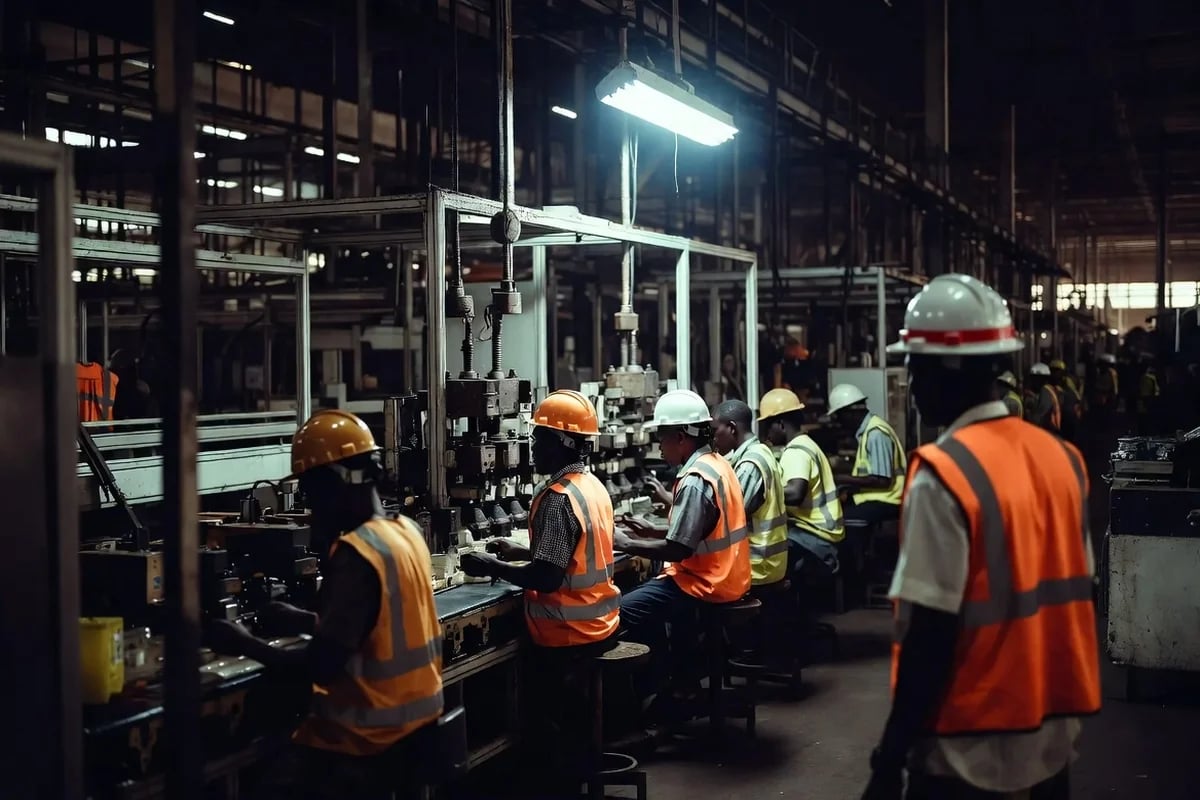
Manufacturing facilities across Ghana and Togo operate under conditions that make process consistency a genuine competitive differentiator. Variable manual-handling dependency, uneven throughput rates, and the compounding costs of line stoppages are not abstract concerns — they are the daily operational reality for processing plants, packaging lines, and assembly operations throughout the region. RoboFactory Africa addresses these conditions through end-to-end automation engagements: beginning with consultation and process mapping, progressing through engineering design and integration, and extending into operator training and structured ongoing support.
The distinction that manufacturing clients consistently identify is the phase-by-phase discipline. Rather than deploying monolithic automation systems that disrupt existing operations wholesale, RoboFactory Africa structures each engagement to allow production continuity while incremental automation gains compound across the facility. This approach is particularly valued by mid-scale and growing manufacturers for whom operational downtime carries immediate revenue consequence.
Specification Requirements Unique to Manufacturing
Manufacturing environments in Ghana and Togo present a distinct set of engineering constraints. Power infrastructure variability, ambient temperature ranges in industrial zones, and the practical realities of spare-parts availability all inform how automation systems must be specified. A system designed without accounting for local grid conditions or regional maintenance capacity is a system that degrades quickly — a reality RoboFactory Africa’s engineering teams factor into every specification from the outset.
Beyond the physical environment, manufacturing clients operate within sector-specific regulatory frameworks governing product quality, worker safety, and — for food, beverage, and pharmaceutical operations — hygiene and contamination control. Automation specifications for these environments must satisfy those standards at the process-design level, not as a retrofit consideration. This is the rigour that separates a specification-grade automation partner from a standard equipment supplier.
Recommended Services for Manufacturing Operations
- Process Automation Consultation — systematic audit of existing production lines to identify automation candidates, throughput bottlenecks, and phase-sequencing priorities
- Control Systems Engineering & Integration — design and deployment of PLC, SCADA, and HMI architectures tailored to the facility’s production logic and operator skill base
- Conveyor, Handling & Assembly Automation — mechanised material flow integration for packaging, sorting, assembly, and transfer operations
- Operator Training Programmes — structured knowledge transfer to in-house teams covering system operation, fault diagnosis, and routine maintenance protocols
- Ongoing Technical Support & Maintenance Contracts — scheduled preventive maintenance and responsive technical support to sustain uptime across commissioned systems
Notable Project Types
Manufacturing engagements typically span two principal scales. The first is the targeted line upgrade — an operation with a specific bottleneck, such as a packaging station or a filling line, where a bounded automation intervention delivers measurable gains in output consistency and reduces the manual-handling exposure that generates quality variance. These projects are well-suited to the phase-by-phase model: a defined scope, a commissioning milestone, and a measurable baseline against which performance is tracked.
The second scale is the integrated facility programme, where automation is designed across multiple production lines within a single site — a food processing plant, a plastics manufacturing operation, or a pharmaceutical packaging facility. These engagements require deeper process-mapping work at the front end and more structured training and handover protocols at the close. In both Ghana and Togo, this category of project is growing as manufacturing investors seek to bring regional facilities in line with the quality and throughput standards their export markets require.
Compliance & Standards Framing for Manufacturing Automation
- Adherence to worker-safety protocols under Ghana’s Factories, Offices and Shops Act 1970 (Act 328) / DFI for machine-guarded automated environments
- Process design compatibility with food-grade and hygiene standards where applicable to the facility type
- Electrical and control-systems engineering to recognised IEC practice relevant to industrial automation deployments — e.g. IEC 61131-3 (PLC programming), IEC 61439 (control panels), ISO 12100 / ISO 10218-2 (machinery & robot-cell safety risk assessment)
- Documentation and change-management protocols that support client quality management system (QMS) requirements
- Training and competency frameworks structured to support ongoing regulatory compliance at operator level
Automation for Manufacturing
RoboFactory Africa is an industrial & factory automation integrator — we build, install and commission physical automation on the production floor. This is not consumer robotics, robotics education, or RPA software. The services that typically carry a manufacturing engagement:
- Industrial Automation & Systems Integration — one accountable team, design to commissioning
- Automation System Design & Engineering — the control architecture and detailed drawings
- Robotic Installation & Integration — palletizing, packaging, welding and handling cells on your line
- Controls & Instrumentation — panels, PLC/SCADA, sensors and transmitters
- Process Automation — line automation engineered to your production target
Engineered to Standard
We engineer to recognised practice — IEC 61131-3, IEC 61439, ISO 12100 / ISO 10218-2, and IEC 61508 / IEC 61511 where the process demands functional safety — and within Ghana’s Factories Act 328 / DFI safety regime. We describe these as the framework we work to, and claim a specific certification or OEM-partner badge only where it is actually held. We serve manufacturers across Accra, Tema and Ghana’s industrial zones, into Togo (Lomé), and the wider West-African market — including international OEMs seeking a capable local integration partner.
Every engagement is scoped and quoted per project — line, scope, robotics and controls, new-build vs retrofit all drive it. We quote against your actual requirement, never an invented figure.
Request a consultation — or scope an automation project: +233 20 531 3333 (Togo / Francophone: +228 96 86 86 75).