
Automation System Design & Engineering
End-to-end automation system design and engineering — from architecture and component specification through detailed drawings and integration planning — built around each client's process requirements and production targets.
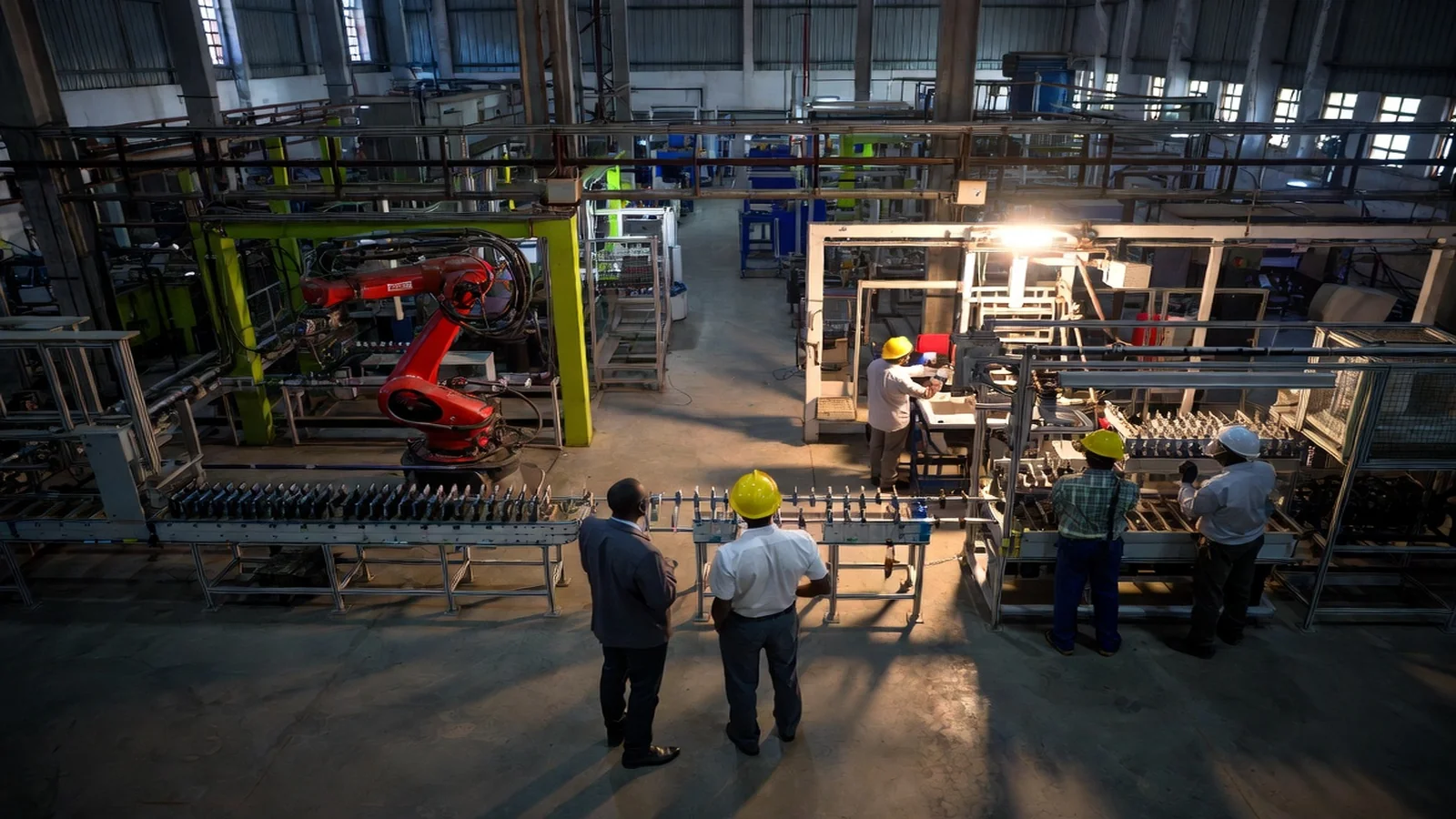
Designing an automation system is an engineering discipline — and to be clear before anything else: RoboFactory Africa does industrial & factory automation engineering (control-system architecture, PLC/SCADA, robotic cells, controls, instrumentation) — not consumer robotics, robotics education, or RPA software. We architect, specify and document automation systems for manufacturers and process plants across Ghana and Togo, since 2018. Request a consultation — or scope an automation project: +233 20 531 3333 (Togo / Francophone: +228 96 86 86 75).
What Is Automation System Design & Engineering?
Automation system design and engineering is the structured discipline of translating a client’s production requirements into a coherent, technically executable automation architecture — before a single component is ordered or a production line is modified. It encompasses the full engineering sequence: process mapping, control system architecture, component specification, integration logic, and the production of detailed engineering drawings that govern every downstream phase of implementation.
Manufacturers, processors, and industrial operators across Ghana and Togo specify this service when they require more than off-the-shelf automation. The work is commissioned by technical directors, plant engineers, and operations leadership who understand that a poorly architected system costs multiples more to correct than to engineer correctly from the outset. The discipline exists precisely at that intersection — where production ambition meets engineering rigour.
When to Specify This Service
Automation system design and engineering is appropriate at the earliest stage of any modernisation, capacity expansion, or greenfield production line project. Food and beverage processing facilities preparing to move from manual batch operations to continuous-flow production, pharmaceutical packaging operations requiring validated control environments, and plastics or chemical processing plants expanding throughput all represent typical commissioning scenarios in the Ghanaian and Togolese industrial context.
It is equally specified when an existing automated facility is undergoing re-engineering — where legacy control systems must be assessed, integration gaps closed, and a forward-looking architecture developed that accommodates phased implementation without disrupting live production. The discipline is the engineering foundation upon which all subsequent automation phases depend.
Methodology — The RoboFactory Africa Specialist Approach
-
Process Discovery & Requirements Definition — Specialists conduct structured interviews with production, operations, and quality teams to capture throughput targets, product variants, process constraints, and regulatory requirements. This shapes the engineering brief.
-
System Architecture Development — Control philosophy, automation topology, and the relationship between sensors, actuators, PLCs, HMIs, and supervisory systems are defined. Architecture decisions at this stage govern total system performance and scalability.
-
Component Specification & Integration Planning — Each control and automation component is selected against the specific process environment — duty cycle, ambient conditions, communications protocol, and compatibility with adjacent systems. Integration points with ERP or production management platforms are mapped at this stage.
-
Engineering Drawing Production — Detailed electrical schematics, panel layouts, network diagrams, and I/O schedules are produced to specification-grade documentation standards. These drawings govern fabrication, procurement, and commissioning teams downstream.
-
Design Review & Client Sign-Off — All engineering documentation is reviewed jointly with the client’s technical leadership. Design intent, integration logic, and phase-by-phase implementation sequencing are confirmed before the project advances to procurement and build phases.
Scope & Standards Framework
- Control system architecture developed to suit the client’s specific process and production environment
- Engineering drawings produced to professional technical documentation standards, suitable for fabrication and third-party review
- Component specifications cross-referenced against process duty, environmental conditions, and communications compatibility
- Integration logic mapped to client’s existing infrastructure — ERP, MES, SCADA, or standalone production management systems as applicable
- Phase-by-phase implementation planning embedded within the design deliverables, enabling staged rollout without production disruption
- All design work conducted within the engineering governance framework applied across RoboFactory Africa’s Ghana and Togo project portfolio
Outcomes for the Client
A completed automation system design and engineering engagement delivers a technically coherent, implementation-ready package — engineering drawings, component specifications, integration plans, and phased implementation schedules — that eliminates ambiguity from every downstream phase. Procurement teams work from defined specifications. Installation teams work from verified drawings. Commissioning teams work from documented integration logic. The result is a materially lower risk profile for the full automation programme, from initial capital commitment through to production sign-off.

Engineered to Standard
- We engineer to recognised practice — IEC 61131-3 (PLC programming), ISO 10218-2 / ISO 12100 (robot-cell & machinery safety risk assessment), IEC 61508 / IEC 61511 (functional safety / SIL where required), IEC 61439 (control-panel assemblies), ISA-95 (MES/ERP integration), IEC 62443 (OT cybersecurity) — and within Ghana’s Factories, Offices and Shops Act 1970 (Act 328) / DFI safety regime
- We describe these as the framework we work to, and claim a specific certification or OEM-partner badge only where it is actually held
- Established 2018 — a real factory-automation engineering and integration practice serving manufacturers and process plants across Ghana (Accra, Tema, the industrial zones) and Togo (Lomé), not a consumer-robotics or software-RPA vendor
Related Services
- Automation Consultation & Assessment — the diagnostic that scopes the brief
- Robotic Installation & Integration — robotic cells onto the line
- Controls & Instrumentation — panels, PLC/SCADA, sensors
- Process Automation — line automation engineered to the target
- Industrial Automation & Systems Integration — design through to a commissioned line