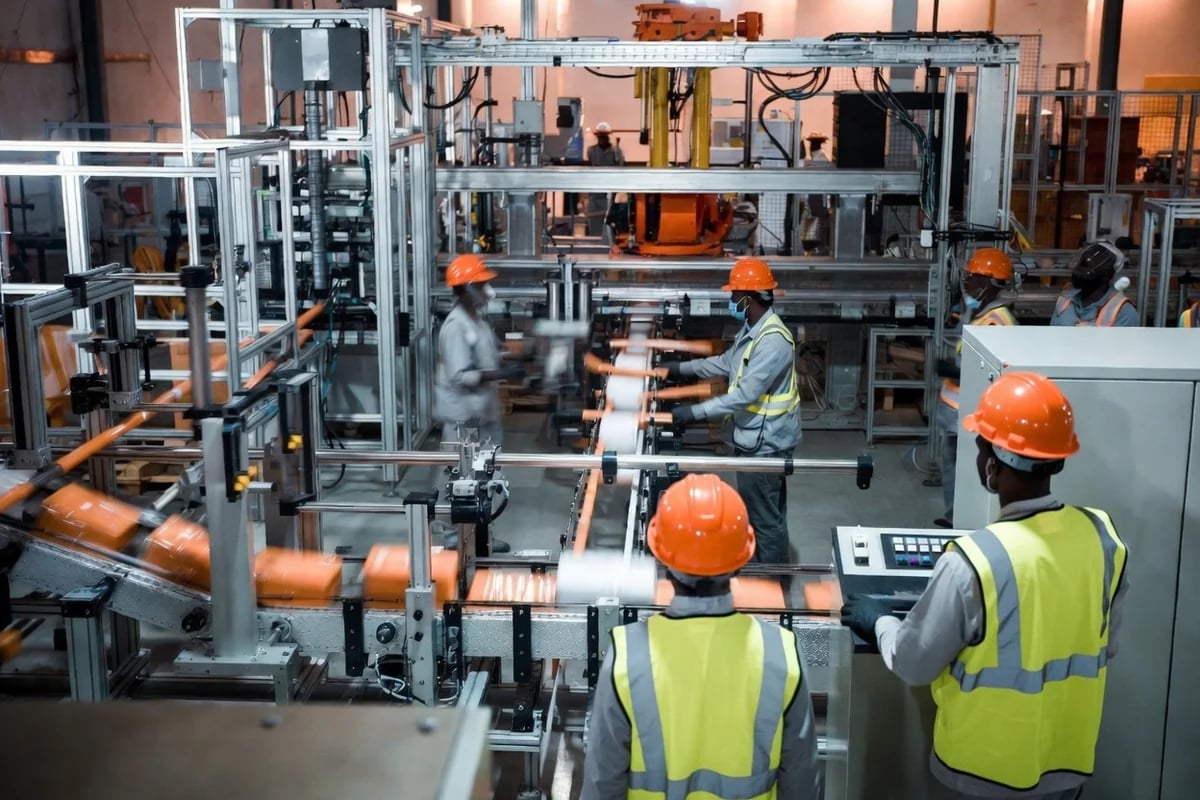
Why Packaging Operations Specify RoboFactory Africa
Packaging lines sit at the intersection of throughput, precision and brand integrity. A misaligned fill, an unlabelled unit, a collapsed pallet — each represents lost yield, compliance exposure and client confidence eroded at the point of dispatch. Packaging sector operators across Ghana and Togo engage RoboFactory Africa because the engineering discipline applied to each line is calibrated to the specific product, container format, output volume and downstream logistics of that operation — not drawn from a generic catalogue.
The end-to-end model matters here more than in almost any other industrial sector. Filling, sealing, labelling and palletising are interdependent stages; a specification decision at the filling station has direct consequences for seal integrity and label adhesion downstream. RoboFactory Africa’s engineers hold the full line in view from the initial consultation brief through commissioning and operator training — ensuring that integration decisions compound in the right direction across every stage.
Specification Requirements Unique to Packaging Operations
Packaging automation in Ghana and Togo must reconcile high-throughput ambition with the practical realities of local utility infrastructure, product diversity and regulatory labelling mandates. Lines handling food-grade liquids, pharmaceutical products, agrochemical preparations or fast-moving consumer goods each carry distinct hygienic design obligations, material contact constraints and traceability requirements that govern how every component of the line is specified and integrated.
Product variability adds a further layer of complexity. Many operations in this region run multiple SKUs, container sizes and closure formats across a single line within a production shift. Automation specifications must therefore accommodate changeover speed, format flexibility and recipe management without compromising the throughput targets that justify the capital investment. These are not abstract engineering considerations — they are the live commercial pressures that drive specification choices at every phase of the project.
Recommended Services for Packaging Operations
- Packaging Line Automation Consultation — Structured assessment of current throughput constraints, format variability demands and integration readiness, producing a phased automation roadmap aligned to operational priorities
- Filling and Sealing System Integration — Engineering and commissioning of liquid, powder, granule or viscous-product filling systems paired with heat-seal, cap-seal or induction-seal closure technologies
- Labelling and Coding System Integration — Automated label application, inkjet coding and vision-based verification configured to product geometry and regulatory marking requirements in Ghana and Togo
- End-of-Line Palletising Automation — Robotic or semi-robotic palletising cells engineered to output rates, pallet pattern requirements and dispatch-floor space constraints
- Operator Training and Ongoing Support — Structured handover programmes and scheduled support cycles ensuring line teams can operate, adjust and maintain automated systems with confidence
Notable Project Types
Packaging automation engagements at RoboFactory Africa typically span the full line scope for medium to large manufacturing operations — from a fast-moving consumer goods producer requiring multi-format liquid filling and tamper-evident sealing to a food processing facility integrating automated weighing, bag-fill and pallet-wrap sequences for export-grade output. Project complexity often increases where a single line must handle ambient, chilled and dry product variants across a common conveyance and palletising infrastructure.
Pharmaceutical and agrochemical packaging engagements carry additional engineering weight — hygienic zone demarcation, closed-loop fill verification and serialisation-ready labelling systems are standard requirements at this tier. RoboFactory Africa’s phase-by-phase engagement model allows operations to begin with the highest-priority bottleneck stage and build out systematically, preserving capital discipline while establishing the integration architecture that future phases will extend.
Compliance and Standards Relevant to Packaging Automation
- Adherence to Ghana Standards Authority (GSA) marking and labelling requirements for consumer-facing packaging
- Food and Drugs Authority (FDA) Ghana hygienic design and product-contact material compliance for food and pharmaceutical lines
- Fill-volume accuracy and net-content declaration obligations applicable to packaged goods in both Ghana and Togo
- Electrical and control system design aligned to Ghana Energy Commission and Togo regulatory standards
- Vision-system and coding integration capable of supporting traceability and batch-recall requirements
- Operator qualification and documented training records aligned to site quality management obligations
Automation for Packaging
RoboFactory Africa is an industrial and factory automation integrator — not a consumer-robotics, robotics-education or RPA-software vendor. For packaging operations that means physical automation on the line: filling, sealing, labelling and palletising engineered, built and commissioned around your product, container format and output target. The relevant capabilities sit across these services:
- Industrial Automation & Systems Integration — one accountable integrator from design to commissioning
- Robotic Installation & Integration — palletising and end-of-line robotic cells on your line
- Process Automation — filling, sealing and labelling sequences engineered to the throughput target
- Controls & Instrumentation — panels, PLC/SCADA, sensors and fill-verification instrumentation
- Automation Retrofits & Upgrades — modernising an existing line without a full rebuild
Engineered to Standard
We engineer to recognised practice — IEC 61131-3 (PLC programming), ISO 10218-2 / ISO 12100 (robot-cell and machinery safety risk assessment), IEC 61439 (control-panel assemblies) and ISA-95 (MES integration where required) — and within Ghana’s factory-safety regime, the Factories, Offices and Shops Act 1970 (Act 328) / DFI, alongside Ghana Standards Authority and Food and Drugs Authority obligations for consumer-packaging marking and product-contact compliance. We describe these as the framework we work to, and claim a specific certification or OEM-partner badge only where it is actually held.
Related Services
- Industrial Automation & Systems Integration
- Robotic Installation & Integration
- Process Automation
- Controls & Instrumentation
- Automation Retrofits & Upgrades
Request a consultation — or scope an automation project: +233 20 531 3333.