The problem
Institutional buyers need a documented, HSE-disciplined source for maintenance & support.
Our approach
Maintenance & Support
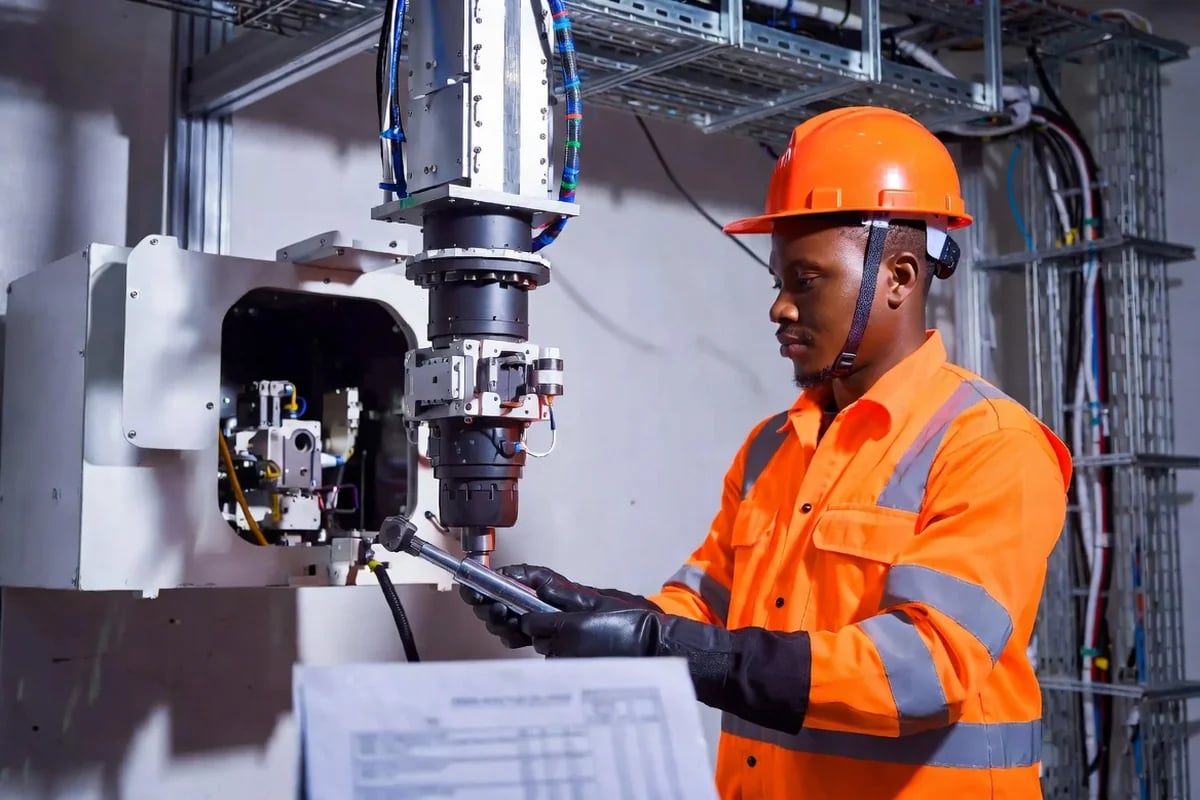
Maintenance & Support delivered to institutional standard — structured procurement, chain-of-custody discipline, documented handover.
The Challenge
Factory automation does not conclude at commissioning. Across manufacturing, processing, and industrial operations in Ghana and Togo, the period following system integration is where operational risk tends to concentrate. Controls drift. Sensors degrade. PLCs accumulate faults that operators are not configured to diagnose. Without a structured support framework in place, minor deviations compound into unplanned downtime — and unplanned downtime in a production environment carries costs that ripple far beyond the immediate stoppage.
The challenge is compounded by the scarcity of qualified automation support capacity in the region. Many facilities that have invested in programmable logic systems, SCADA platforms, or conveyor and dosing automation find themselves dependent on offshore vendor support chains that are slow to respond and poorly calibrated to local operating conditions. The result is a maintenance posture that is reactive rather than engineered — patching faults as they surface rather than preventing them through structured monitoring and intervention cycles.
Industrial clients operating at institutional scale cannot absorb that risk. Whether the facility is a pharmaceutical blending line, a food and beverage processing plant, or a packaging and palletising operation, the expectation is that automation systems perform continuously, that faults are diagnosed with precision, and that support response is documented, traceable, and aligned to the operational calendar of the facility.
The RoboFactory Africa Solution
RoboFactory Africa structures Maintenance and Support as a managed engineering service — not a helpdesk function. Support engagement begins with a documented baseline audit of the installed automation systems: controls architecture, sensor condition, actuator performance, communication network integrity, and software version status. That baseline becomes the reference against which all subsequent maintenance activity is measured and recorded.
Scheduled maintenance cycles are designed around the operational rhythm of each facility. Shift patterns, planned shutdown windows, and production calendars are incorporated into the maintenance programme so that intervention work does not compete with live production. Each visit generates a structured condition report, with findings, actions taken, and any forward recommendations documented in a format suitable for facility management review and regulatory compliance records.
Remote monitoring integration is available as an extension of the support framework for facilities with suitable network infrastructure. Where on-site presence is required, RoboFactory Africa deploys automation specialists based in Ghana and Togo — local teams with direct knowledge of the installed systems, eliminating the delay and translation loss inherent in remote vendor escalation paths.
Service Scope and Disciplines
- Structured condition auditing of PLC, SCADA, HMI, and sensor arrays against documented baseline
- Scheduled preventive maintenance calibrated to facility production calendars and planned shutdown windows
- Fault diagnosis and corrective intervention with full chain-of-custody documentation
- Remote monitoring integration for facilities with suitable industrial network infrastructure
- Operator and technician knowledge transfer, ensuring in-house teams can manage first-line responses
- Software version management, backup discipline, and controls configuration archiving
Typical Engagement Profile
A Maintenance and Support engagement typically follows system commissioning and is structured as an ongoing managed service, calibrated to facility scale and automation complexity. Clients include pharmaceutical manufacturers, food and beverage processors, packaging operations, and industrial production facilities across Ghana and Togo. Engagement scope ranges from single-line support programmes through to multi-system facility-wide maintenance frameworks covering several integrated automation zones. Programme reviews are conducted at defined intervals, with scope adjustments made in response to operational changes, system upgrades, or facility expansion phases.
Outcomes
- Measurable reduction in unplanned downtime through structured preventive intervention cycles
- Complete maintenance audit trail suitable for facility management reporting and regulatory review
- In-house operator capability strengthened through documented knowledge transfer programmes
- Faster fault resolution through local specialist deployment rather than offshore vendor escalation
- Automation systems maintained in alignment with original engineering specifications, protecting the capital investment in the installed infrastructure