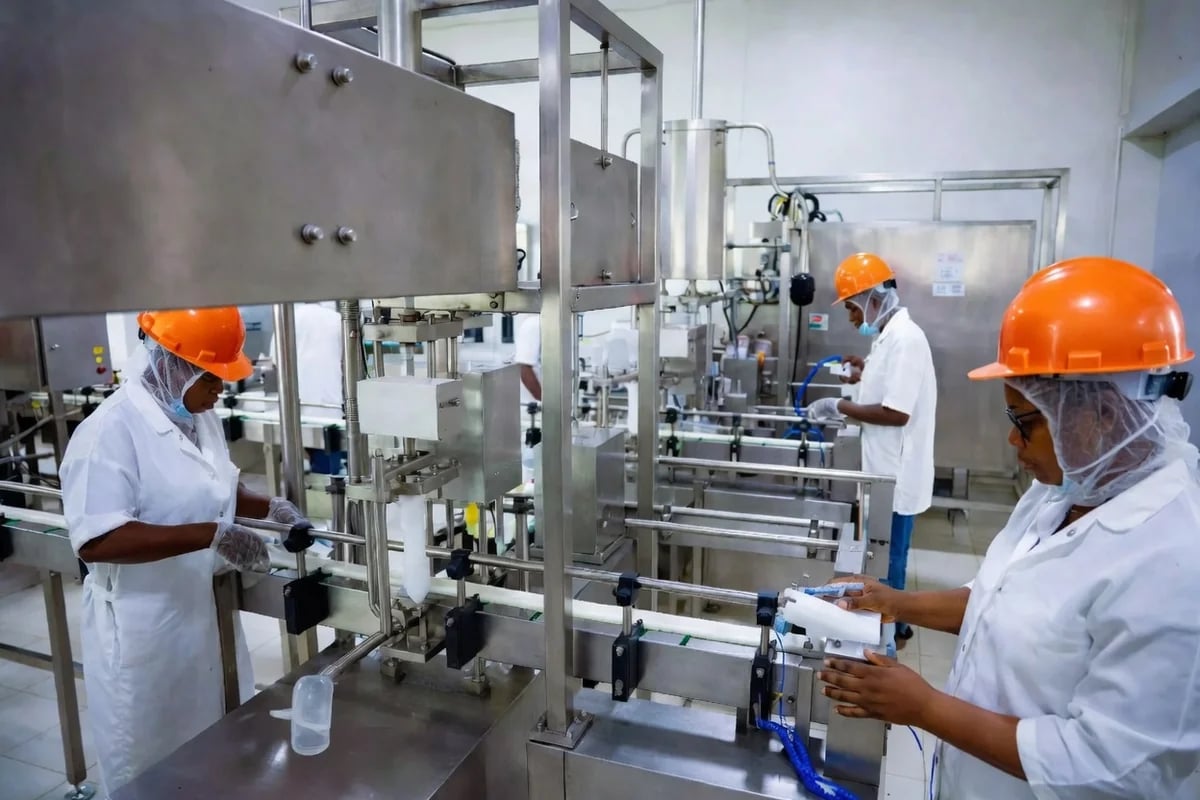
Why Food & Beverage Processors Specify RoboFactory Africa
Food and beverage processing demands a level of operational discipline that general industrial automation cannot adequately address. Throughput consistency, hygiene integrity, and the precise sequencing of filling, sealing, mixing, and portioning lines require automation systems engineered specifically for the demands of food-grade environments — not adapted from unrelated industrial templates.
Across Ghana and Togo, processing facilities that have moved from manual or semi-manual lines to fully integrated automation report a qualitative shift in batch consistency, waste reduction, and line-speed predictability. RoboFactory Africa approaches every food and beverage engagement phase by phase — beginning with a structured consultation that maps current throughput gaps before a single control panel is specified — ensuring that automation investment is calibrated precisely to each facility’s operational reality.
Specification Requirements Unique to Food & Beverage Processing
Food and beverage automation operates under constraints that do not apply to general manufacturing. Hygienic design is non-negotiable: surfaces, conveyance mechanisms, filling heads, and sensor housings must support clean-in-place or wash-down cycles without harbouring contamination. Control architecture must accommodate frequent product changeovers without compromising calibration or traceability, and line configurations must allow rapid sanitation without disassembly that defeats the efficiency purpose of automation in the first place.
Regulatory exposure in this sector is compressive. Facilities supplying organised retail, export markets, or institutional food service in Ghana and Togo must demonstrate process documentation, lot traceability, and measurable quality checkpoints. Automation systems that cannot generate that audit trail are liabilities, not assets. RoboFactory Africa engineers traceability and documentation logic into the control layer from the outset — not as a retrofit.
Recommended Services for Food & Beverage Facilities
- Process Line Audit & Automation Roadmap — systematic assessment of current line performance, bottlenecks, and hygiene risk points, producing a phased automation specification
- Hygienic Control System Design & Integration — PLC and HMI architecture configured for wash-down environments, product changeover management, and real-time process monitoring
- Filling, Portioning & Packaging Line Automation — end-to-end integration of volumetric filling, portioning, labelling, and secondary packaging sequences
- Operator & Maintenance Training — structured knowledge transfer ensuring in-house teams can operate, monitor, and maintain automated systems with full operational independence
- Ongoing Technical Support & Preventive Maintenance — scheduled service programmes and responsive technical support to protect line uptime across the production calendar
Notable Project Types
RoboFactory Africa has delivered automation programmes across a range of food and beverage facility types in Ghana and Togo. Typical engagements include the phased automation of beverage filling and capping lines at mid-scale production facilities, where the priority is eliminating volume variance and improving fill-rate consistency across shift changes. Equally common are integrated packaging line projects at processed-food manufacturers, where upstream portioning automation is connected to downstream labelling and case-packing systems through a unified control architecture.
Larger-scale engagements have addressed full production hall automation for facilities scaling from artisanal or semi-industrial output toward organised commercial distribution — a transition that requires not only technical integration but structured change management for production teams. In each case, the engagement begins with consultation, proceeds through engineering and phased commissioning, and concludes only when the client’s in-house team has demonstrated full operational competence.
Compliance & Standards Orientation
- Hygienic design principles aligned with food-grade automation standards for surface materials, drainage, and ingress protection
- Clean-in-place and wash-down compatibility across all wetted and proximate automation components
- Lot traceability and process data logging integrated at the control layer to support regulatory and retailer audit requirements
- Product changeover protocols that preserve calibration integrity and document configuration changes
- Operator safety standards embedded in control logic, including interlocks, emergency stop architecture, and access control under Ghana’s Factories, Offices and Shops Act 1970 (Act 328) / DFI safety regime
- Alignment with Ghana Food and Drugs Authority (FDA) process documentation expectations for licensed food processing facilities
Automation for Food & Beverage Processing
RoboFactory Africa is an industrial & factory automation integrator — physical process automation engineered into the line. This is not consumer robotics, robotics education, or RPA software. The services that typically carry a food & beverage engagement:
- Industrial Automation & Systems Integration — one accountable team, design to commissioning
- Process Automation — filling, sealing, mixing and portioning lines automated to the target
- Controls & Instrumentation — wash-down-rated panels, PLC/SCADA, sensors and transmitters
- Automation System Design & Engineering — hygienic control architecture and detailed drawings
- Robotic Installation & Integration — case-packing, palletizing and handling cells
Engineered to Standard
We engineer to recognised practice — IEC 61131-3 (PLC programming), IEC 61439 (control panels), ISO 12100 / ISO 10218-2 (machinery & robot-cell safety), with hygienic-design and traceability logic built into the control layer — within Ghana’s Factories Act 328 / DFI safety regime and aligned to Ghana FDA documentation expectations for licensed food facilities. We describe these as the framework we work to, and claim a specific certification only where it is actually held. We serve processors across Accra, Tema and Ghana’s industrial zones, into Togo (Lomé) and the wider West-African market.
Every engagement is scoped and quoted per project — line, scope, hygiene constraints and new-build vs retrofit all drive it. We quote against your actual requirement, never an invented figure.
Request a consultation — or scope an automation project: +233 20 531 3333 (Togo / Francophone: +228 96 86 86 75).