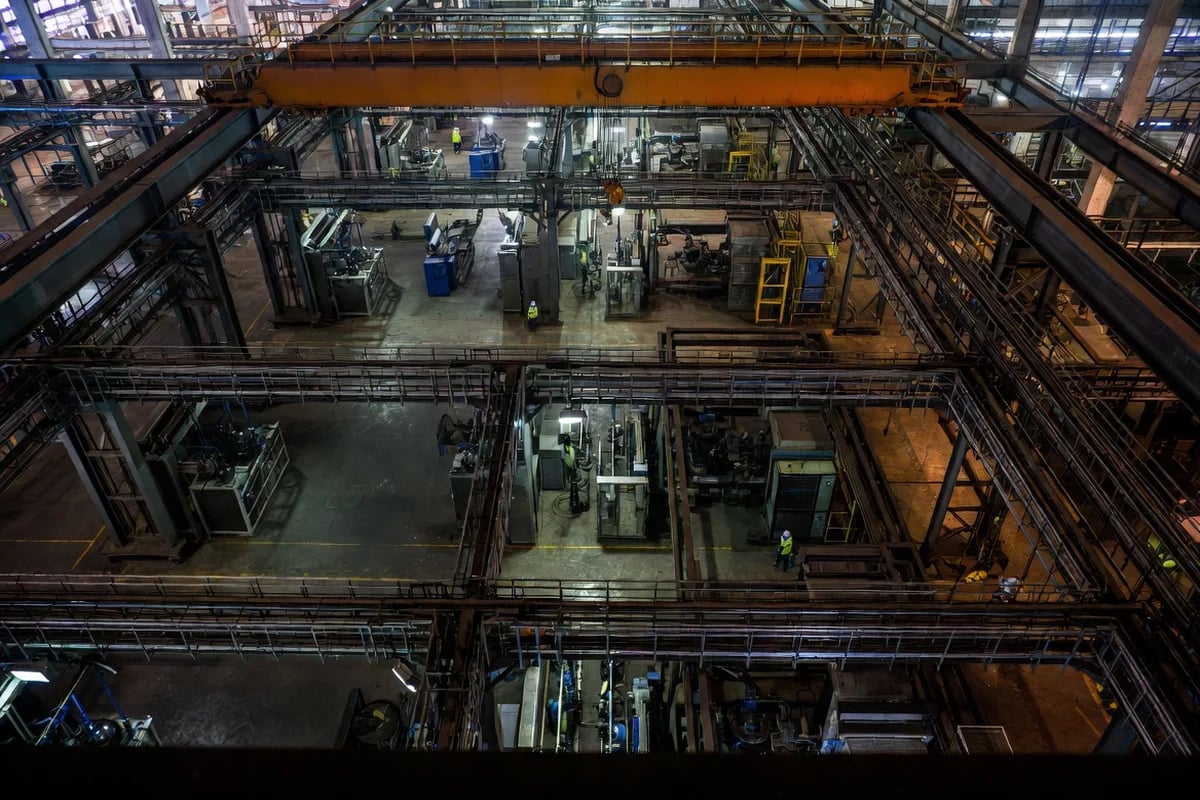
Why Industrial Plants Specify RoboFactory Africa
Industrial facilities across Ghana and Togo operate under conditions that demand more than off-the-shelf automation solutions. Legacy production lines, phased capital programmes, mixed-vintage equipment fleets and the operational reality of continuous manufacturing all converge to create integration challenges that require disciplined, engineering-led thinking rather than catalogue procurement. RoboFactory Africa was built precisely for this environment — providing end-to-end automation and controls integration that moves from initial consultation through detailed engineering, commissioning, operator training and sustained support without the handoff gaps that typically erode project outcomes.
For plant managers and capital project engineers, the appeal is structural: one specialist team holds accountability across the full programme arc. Whether a facility is undertaking a full-floor automation upgrade, retrofitting discrete production cells or introducing supervisory control layers over existing equipment, RoboFactory Africa delivers phased integration that keeps production continuity central to every engineering decision.
Specification Requirements Unique to Industrial Plants
Industrial plant automation carries a level of technical and operational specificity that distinguishes it sharply from lighter commercial automation contexts. Control architecture must accommodate real-time process data across multiple PLCs, SCADA layers and field instrumentation — frequently in environments with high ambient heat, particulate contamination or high-voltage adjacency. In Ghana and Togo, additional specification rigour is required to address grid instability, the availability of qualified maintenance personnel post-commissioning and the logistical reality of sourcing replacement components within regional supply chains.
Phased upgrade programmes introduce further complexity: existing production schedules cannot absorb extended downtime windows, which means that integration sequences must be engineered to allow parallel operation during transition periods. RoboFactory Africa’s project methodology accounts for these constraints at the engineering design stage — not as afterthoughts managed on-site — ensuring that specifications are buildable within the operational boundaries the plant actually faces.
Recommended Services for Industrial Plants
- Automation Consultation and Feasibility Engineering — systematic assessment of current production architecture, gap analysis and phased upgrade roadmap development
- PLC and SCADA Integration — design, programming and commissioning of control systems across single or multi-cell production environments
- System Retrofits and Controls Modernisation — upgrading legacy control panels, field devices and supervisory systems without full line replacement
- Operator and Maintenance Training — structured knowledge transfer programmes aligned to the specific systems commissioned on site
- Ongoing Technical Support and Remote Monitoring — post-commissioning support structures that sustain system performance through the production lifecycle
Notable Project Types
Industrial plant engagements typically involve either full-floor automation programmes for newly commissioned manufacturing facilities or phased retrofit sequences for established operations seeking to improve throughput, reduce manual intervention or bring supervisory visibility to previously isolated production cells. Across Ghana’s industrial corridors and Togo’s growing processing sector, RoboFactory Africa has delivered controls integration for food and beverage processing lines, plastics manufacturing operations, packaging and palletising cells, and mixed-use industrial facilities requiring unified automation architecture across heterogeneous equipment fleets.
A characteristic project type involves a multi-phase production upgrade where early phases stabilise critical process controls and establish the data infrastructure, while later phases layer in advanced supervisory functions, remote diagnostics and predictive maintenance capability. This sequenced approach protects capital allocation and allows plant management to validate performance at each stage before committing to subsequent phases.
Compliance and Standards Alignment
- Adherence to IEC 61131-3 structured programming standards for PLC logic development across all commissioned systems
- Electrical panel design and field wiring practices aligned to IEC 60204-1 safety of machinery requirements
- SCADA and HMI architecture designed to support audit-ready data logging and operator access control
- Functional safety assessment considerations consistent with IEC 62061 principles for machinery control systems
- Integration documentation delivered to client specification, supporting regulatory inspection and internal quality management frameworks
- Local regulatory requirements — Ghana’s factory-safety regime under the Factories, Offices and Shops Act 1970 (Act 328) / Department of Factories Inspectorate (DFI), and Togo’s industrial licensing frameworks — incorporated into project planning from the engineering stage
Automation for Industrial Plants
RoboFactory Africa is an industrial and factory automation integrator — not a consumer-robotics, robotics-education or RPA-software vendor. For industrial plants that means physical controls and automation across the floor: PLC/SCADA layers, retrofits, instrumentation and phased upgrade programmes engineered around continuous production. The relevant capabilities sit across these services:
- Industrial Automation & Systems Integration — one accountable integrator from design to commissioning
- Automation Retrofits & Upgrades — legacy-line modernisation and control-system migration without full replacement
- Controls & Instrumentation — panels, PLC/SCADA, field devices and supervisory systems
- Process Automation — line and process automation engineered to the production target
- Robotic Installation & Integration — robotic cells integrated into existing plant lines
Engineered to Standard
We engineer to recognised practice — IEC 61131-3 (PLC programming), IEC 60204-1 and IEC 62061 (machinery safety and functional safety), IEC 61439 (control-panel assemblies) and ISA-95 (MES integration where required) — and within Ghana’s factory-safety regime, the Factories, Offices and Shops Act 1970 (Act 328) / DFI. We describe these as the framework we work to, and claim a specific certification or OEM-partner badge only where it is actually held.
Related Services
- Industrial Automation & Systems Integration
- Automation Retrofits & Upgrades
- Controls & Instrumentation
- Process Automation
- Robotic Installation & Integration
Request a consultation — or scope an automation project: +233 20 531 3333.