The problem
Institutional buyers need a documented, HSE-disciplined source for robotic installation & integration.
Our approach
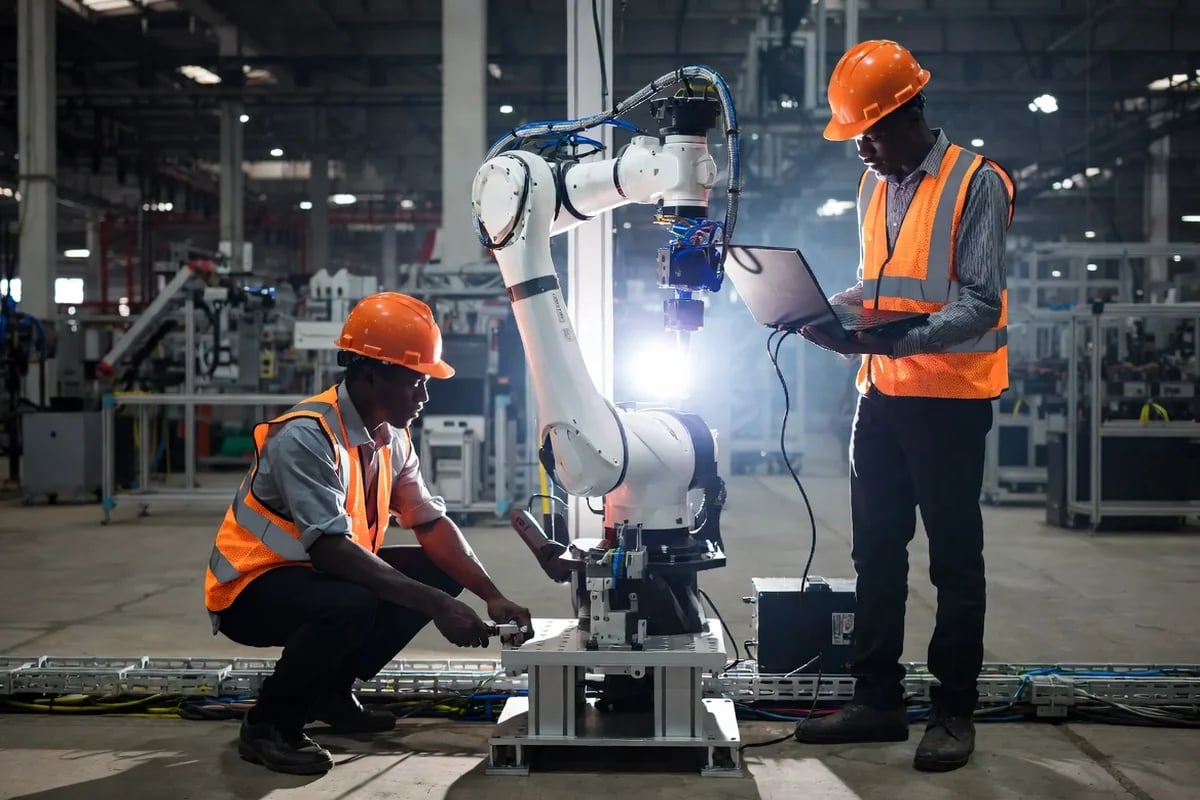
Robotic Installation & Integration
Robotic Installation & Integration delivered to institutional standard — structured procurement, chain-of-custody discipline, documented handover.
The Challenge
Manufacturing and processing operations across Ghana and Togo face a structural tension: the competitive pressure to increase throughput and reduce variance is intensifying, yet the pathway to industrial robotics remains opaque for most facility operators. Equipment procurement, systems integration, safety validation, and operator readiness each represent distinct technical disciplines — and without a single coordinating authority, projects fragment across vendors, timelines slip, and commissioning outcomes fall short of design intent.
The consequences of fragmented integration are rarely visible on a purchase order but become acute on the production floor. Robotic cells that are mechanically installed but electrically misconfigured, PLCs that are programmed in isolation from upstream conveyor logic, and operators trained on manuals rather than live systems — these are the failure modes that erode the return on capital that automation is meant to deliver. The sector deserves a more rigorous standard.
Institutional clients in food processing, pharmaceutical manufacturing, consumer goods assembly, and industrial packaging across Accra, Tema, and Lomé have increasingly recognised that robotic integration is not a procurement event — it is an engineering programme. The discipline required to execute it well is the discipline RoboFactory Africa brings to every engagement.
The RoboFactory Africa Solution
RoboFactory Africa approaches robotic installation and integration as a structured, phase-gated programme rather than a transactional deployment. Engagement begins with a detailed process audit: mapping current material flow, identifying cycle-time bottlenecks, assessing floor layout constraints, and establishing the automation readiness of existing equipment. This diagnostic phase produces a specification brief that governs every subsequent decision — from robot model selection to end-effector design to control architecture.
Integration work is executed under a chain-of-custody discipline that tracks each system component from receipt through commissioning. Robotic arms, vision systems, safety fencing, collaborative modules, and SCADA connectivity are each validated against the original specification brief before the cell is declared commission-ready. Nothing advances to operator handover until the integrated system performs within the documented parameters agreed at programme inception.
The methodology closes with a structured knowledge transfer: operators and maintenance personnel are trained on live systems, not simulations alone, and documentation packages are handed over in full — wiring diagrams, PLC logic, maintenance schedules, and calibration records. The client receives not just a functioning robotic cell, but the institutional knowledge to sustain it.
System & Process Specification
- Robot platforms: articulated arm, SCARA, delta, and collaborative robot configurations selected against process requirements
- Control architecture: PLC and HMI integration aligned to existing or specified SCADA infrastructure
- End-effector engineering: custom gripper, suction, and tool-change systems designed for the specific product and cycle
- Safety compliance: perimeter guarding, light curtains, area scanners, and risk-assessment documentation to international safety standards
- Vision and sensing: inline inspection, part-location, and quality-gate systems integrated into the robotic cell logic
- Documentation handover: full as-built records, maintenance manuals, and calibration baselines delivered at project close
Typical Project Profile
A representative engagement involves a mid-scale processing or assembly facility in the Greater Accra or Tema industrial corridor — or a manufacturing operation in Lomé — seeking to automate a defined production stage: palletising, pick-and-place assembly, packaging line integration, or quality inspection. Project scope typically spans initial audit through commissioning across a structured multi-phase timeline, with each phase gate requiring sign-off before mobilisation of the next. Sectors served include food and beverage processing, pharmaceutical production, consumer goods assembly, and industrial packaging.
Outcomes
- Documented cycle-time performance against pre-integration baseline, established during the process audit phase
- Operator and maintenance teams trained to sustain and adjust the integrated system without third-party dependency
- Full chain-of-custody records from component receipt to commissioned handover
- Reduced process variance through consistently programmed, calibrated robotic execution
- A facility positioned to scale automation in subsequent phases from a validated, well-documented foundation