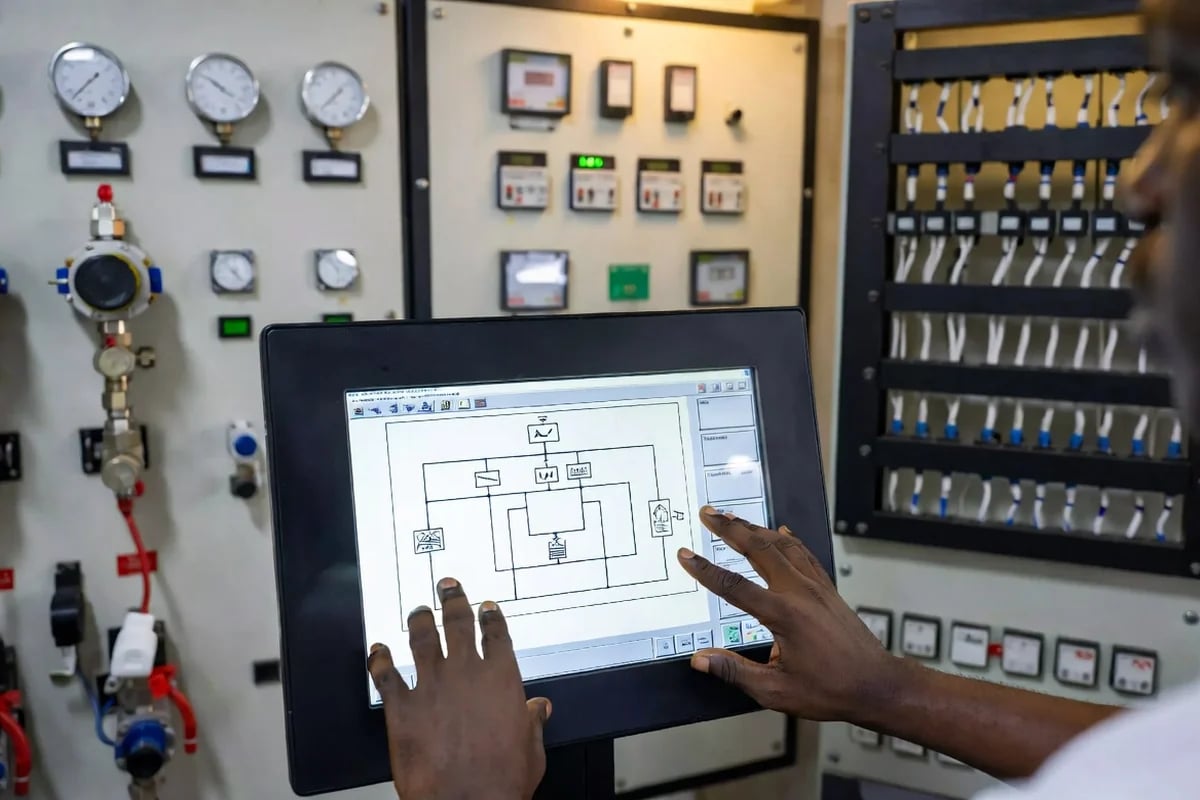
Controls & Instrumentation
Design, supply and commissioning of control systems and instrumentation — PLCs, SCADA, sensors and field devices — engineered to govern and monitor automated factory processes with precision and reliability.
Controls and instrumentation is the control layer of factory automation — and to be clear before anything else: RoboFactory Africa engineers industrial controls & instrumentation (PLC, SCADA, HMI, sensors, transmitters, field networks) on real process plant — not consumer robotics, robotics education, or RPA software. We design, supply and commission control systems for manufacturers and process plants across Ghana and Togo, since 2018. Request a consultation — or scope an automation project: +233 20 531 3333 (Togo / Francophone: +228 96 86 86 75).
What is Controls & Instrumentation?
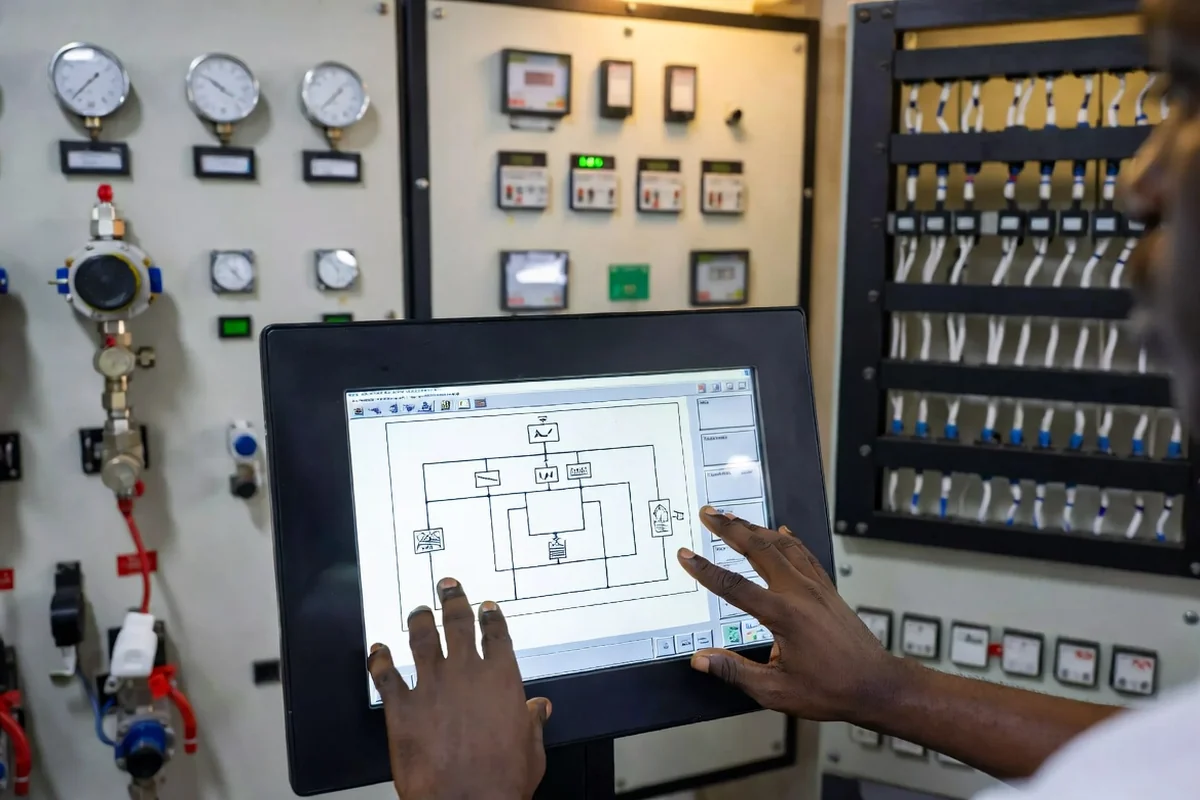
Controls and instrumentation engineering is the discipline that gives an automated factory its intelligence. It encompasses the design, supply, configuration and commissioning of the systems that govern process behaviour — programmable logic controllers (PLCs), supervisory control and data acquisition platforms (SCADA), human-machine interfaces (HMIs), field sensors, transmitters, actuators and the network architectures that bind them into a coherent operational picture.
Where mechanical and electrical infrastructure provides the muscle of a production facility, controls and instrumentation provides the nervous system. Process variables — temperature, pressure, flow, level, speed, position — are measured continuously by field devices, communicated to control logic, and acted upon in real time. Manufacturers, processing operations and industrial facilities across Ghana and Togo specify this discipline when precision, repeatability and documented process governance are non-negotiable.
When to Specify Controls & Instrumentation
This service is essential at any point in the facility lifecycle where process variability represents a risk — at greenfield commissioning, during capacity expansion, or when ageing analogue control panels are replaced with modern digital architecture. Manufacturing operations in food and beverage processing, pharmaceutical production, cement and building materials, plastics, chemical blending, and industrial utilities all depend on well-engineered control and instrumentation layers to sustain output quality and regulatory compliance.
Project types that routinely require this scope include: new production line integration, legacy system migration, process optimisation retrofits, utility automation (compressed air, cooling, steam), and safety instrumented system upgrades. Facilities operating across multiple sites in Ghana and Togo also specify centralised SCADA architectures to consolidate visibility and reporting across geographically distributed plant.
Methodology — The RoboFactory Africa Specialist Approach
-
Process & Control Philosophy Review — Specialists engage the client’s engineering and operations teams to document process requirements, define control objectives and establish the functional design specification that governs all subsequent engineering decisions.
-
System Architecture Design — Control system topology is engineered: PLC platform selection, I/O count and distribution, network protocol specification (industrial Ethernet, Profibus, Modbus or fieldbus variants), SCADA server architecture and HMI layout — all matched to the process demand and the client’s long-term maintainability requirements.
-
Supply & Panel Engineering — Control panels are designed to drawing, components are sourced to specification, and panel build is executed with rigour — cable segregation, labelling conventions, earthing schemes and protection rating appropriate to the industrial environment.
-
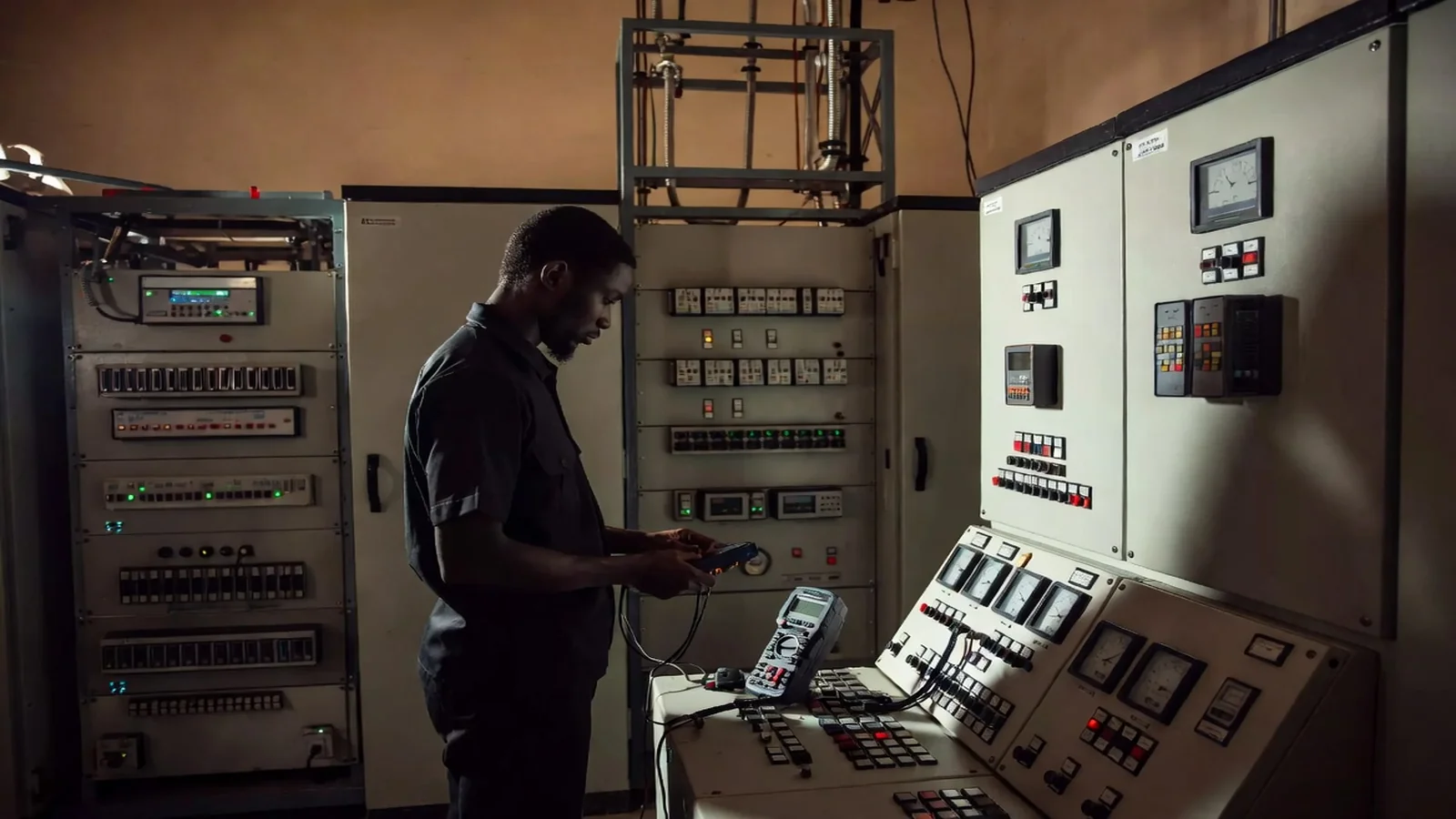
Site Commissioning & Loop Testing — Each instrument loop is commissioned individually: calibration checks, signal verification, interlock testing and control loop tuning are completed before any process medium is introduced, eliminating commissioning risk to production assets.
-
Operator Handover & Documentation — Commissioning concludes with structured operator training, delivery of as-built documentation, calibration records and a control system maintenance schedule — equipping the client’s team to sustain performance from day one.
Scope & Standards
- PLC and SCADA platforms selected from internationally recognised industrial automation manufacturers
- Field instruments specified to industrial protection ratings appropriate to the process environment and ambient conditions in West African industrial sites
- Control panel construction referencing IEC low-voltage switchgear and controlgear assembly standards
- Network and communication architecture designed with cybersecurity and redundancy considerations relevant to continuous-process environments
- Instrument calibration and loop documentation maintained to a traceable, auditable standard
- SCADA historian and reporting functionality configured to support management visibility and process improvement programmes
Outcomes
A well-executed controls and instrumentation scope delivers a production environment where process variables are governed with precision, deviations are detected and acted upon in real time, and operational data is structured for both day-to-day management and long-term improvement. Clients report measurable reductions in process variability, faster fault diagnosis and greater confidence in product quality consistency. RoboFactory Africa provides ongoing support agreements to sustain system performance across the operational lifetime of the facility.
Engineered to Standard
- We engineer to recognised practice — IEC 61131-3 (PLC programming), IEC 61439 (control-panel assemblies), IEC 61508 / IEC 61511 (functional safety / SIL where required), ISA-95 (MES integration), IEC 62443 (OT cybersecurity) — and within Ghana’s Factories, Offices and Shops Act 1970 (Act 328) / DFI safety regime
- We describe these as the framework we work to, and claim a specific certification or OEM-partner badge only where it is actually held
- Established 2018 — a real factory-automation integrator engineering controls and instrumentation on process plant across Ghana (Accra, Tema, the industrial zones) and Togo (Lomé), not a consumer-robotics or software-RPA vendor
Related Services
- Automation System Design & Engineering — the architecture phase
- Robotic Installation & Integration — robotic cells onto the line
- Process Automation — line automation engineered to the target
- Maintenance & Support — post-commissioning support and preventive maintenance
- Industrial Automation & Systems Integration — design through to a commissioned line