The problem
Institutional buyers need a documented, HSE-disciplined source for custom automation solutions.
Our approach
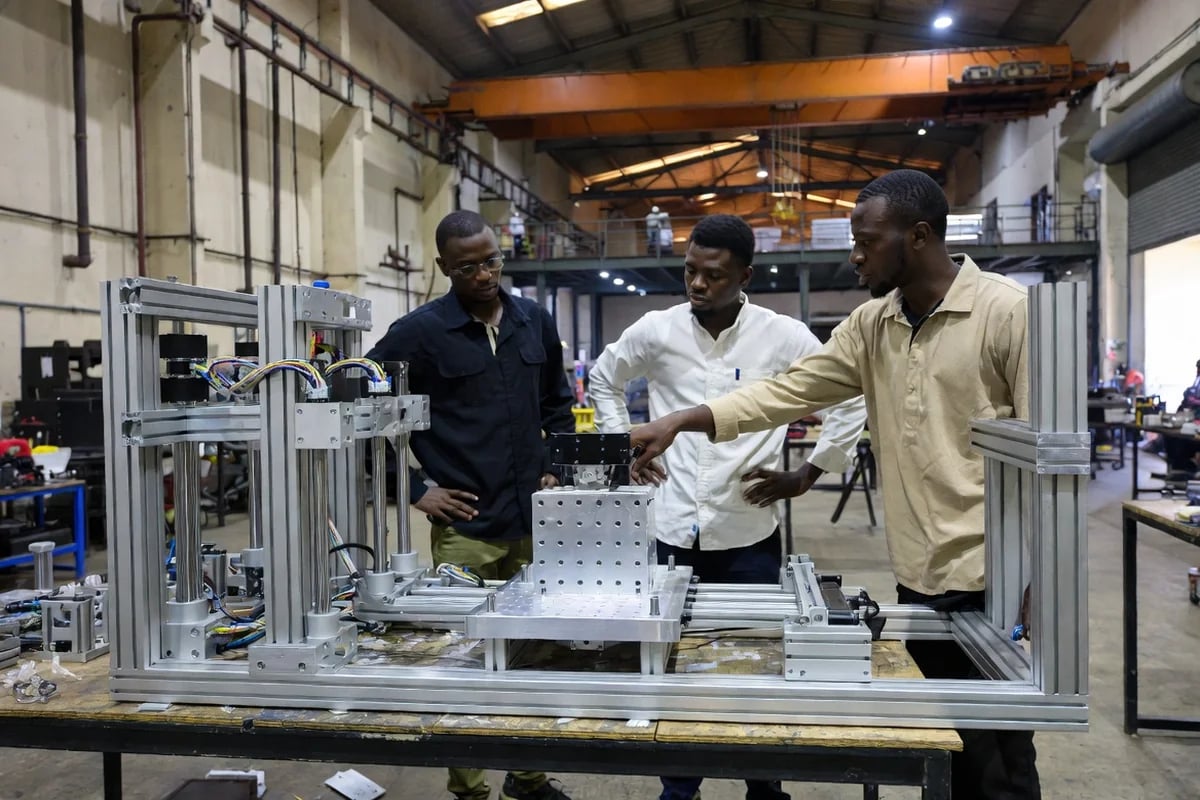
Custom Automation Solutions
Custom Automation Solutions delivered to institutional standard — structured procurement, chain-of-custody discipline, documented handover.
The Challenge
Manufacturing and processing operations across Ghana and Togo face a compounding set of pressures: rising input costs, inconsistent throughput, quality variance driven by manual handling, and workforces stretched across repetitive, low-yield tasks. The gap between what a facility produces today and what its infrastructure could theoretically deliver is rarely a question of capital alone — it is almost always a question of integration discipline.
Off-the-shelf automation packages address isolated problems in isolation. A conveyor retrofit here, a sensor upgrade there. What they rarely deliver is a coherent, engineered system in which every component — mechanical, electrical, software, and human — operates in documented alignment. The result is a patchwork of interventions that each solve one problem while quietly introducing another.
Institutional manufacturers, processors, and industrial operators in this sub-region require something structurally different: a custom automation programme built from first principles, sequenced to their operational reality, and delivered with the chain-of-custody discipline that a Tier-1 procurement committee can audit from brief to handover.
The RoboFactory Africa Solution
RoboFactory Africa’s approach begins before a single component is specified. The engagement opens with a structured consultation phase — a systematic audit of existing processes, throughput bottlenecks, safety exposure points, and workforce deployment patterns. This diagnostic stage produces a documented automation brief that forms the contractual backbone of every subsequent phase.
Engineering follows procurement logic: systems are designed around the client’s actual production environment, not adapted from generic templates. Each solution is composed of precisely selected mechanical, electrical, and control-layer components, specified for the operational conditions present in Ghana and Togo’s manufacturing environments — humidity, power supply variability, shift-length demands, and maintenance-access realities.
Deployment proceeds phase by phase, so production continuity is preserved throughout. Specialist commissioning teams handle integration, calibration, and operator training within a structured handover protocol. Documentation — wiring schematics, control-system logic, maintenance schedules, and operator manuals — is delivered as a complete technical record, not an afterthought.
System + Process Specification
- Structured diagnostic audit — process mapping, bottleneck analysis, and safety exposure assessment conducted prior to any engineering commitment
- Custom control architecture — PLC and HMI configurations engineered to the specific production sequence, not adapted from off-the-shelf templates
- Phase-by-phase deployment — sequenced rollout that preserves operational continuity throughout the integration programme
- Operator training programme — structured, documented training delivered to shift supervisors and line operators at commissioning handover
- Complete technical documentation package — schematics, control-logic records, maintenance schedules, and operator manuals delivered as a formal project archive
- Ongoing support framework — scheduled maintenance access, remote diagnostic capability, and specialist response protocols established post-handover
Typical Project Profile
A representative engagement involves a mid-to-large manufacturing or processing facility in Ghana or Togo seeking to reduce manual handling exposure, increase line throughput, or standardise quality output across production shifts. Project scope typically spans initial diagnostic consultation through to full commissioning and operator handover, with implementation sequenced across defined phases to minimise downtime. Sectors served include food and beverage processing, pharmaceutical manufacturing, consumer goods production, agro-industrial operations, and light industrial assembly — any environment where process consistency and throughput discipline are primary operational priorities.
Outcomes
- Throughput consistency — production lines operate to documented parameters rather than shift-to-shift manual variance
- Reduced manual handling exposure — repetitive and safety-critical tasks are transferred to engineered systems, redeploying workforce to higher-value roles
- Auditable integration record — every phase of the programme produces a formal documentation trail suitable for internal governance, insurance, and regulatory review
- Operational continuity during deployment — phased implementation methodology ensures production is not suspended for the duration of the integration programme
- Capability retained in-house — structured operator training and complete technical documentation ensure the client’s team can operate, maintain, and build on the installed system independently