The problem
Institutional buyers need a documented, HSE-disciplined source for automation retrofits & upgrades.
Our approach
Automation Retrofits & Upgrades
Automation Retrofits & Upgrades delivered to institutional standard — structured procurement, chain-of-custody discipline, documented handover.
The Challenge
Manufacturing and processing operations across Ghana and Togo often reach a crossroads: ageing equipment that still carries productive capacity, but control systems, sensors, and sequencing logic that no longer meet the demands of current output volumes or quality standards. Replacing an entire production line carries capital cost and operational disruption that most facility managers cannot absorb in a single budget cycle. The result is a facility that continues to run — but runs below its engineered potential, accumulates unplanned downtime, and exposes operators to process variance that compounds over time.
The retrofitting decision is rarely straightforward. Equipment from multiple generations, sourced across different supply windows, creates integration complexity that generic automation vendors are poorly positioned to resolve. Each machine carries its own communication protocols, mechanical tolerances, and control architectures. Without a structured diagnostic methodology, a retrofit programme risks introducing new failure modes into the very systems it was commissioned to stabilise.
Across the industrial corridors of Accra, Tema, and extending into Lomé, the pressure to modernise without full-line replacement is acute. Regulatory expectations around production documentation, traceability, and process consistency are tightening. Facility operators require an integration partner with the diagnostic rigour to assess what can be upgraded, the engineering discipline to specify what must be replaced, and the project governance to execute both without interrupting the production calendar more than the scope demands.
The RoboFactory Africa Solution
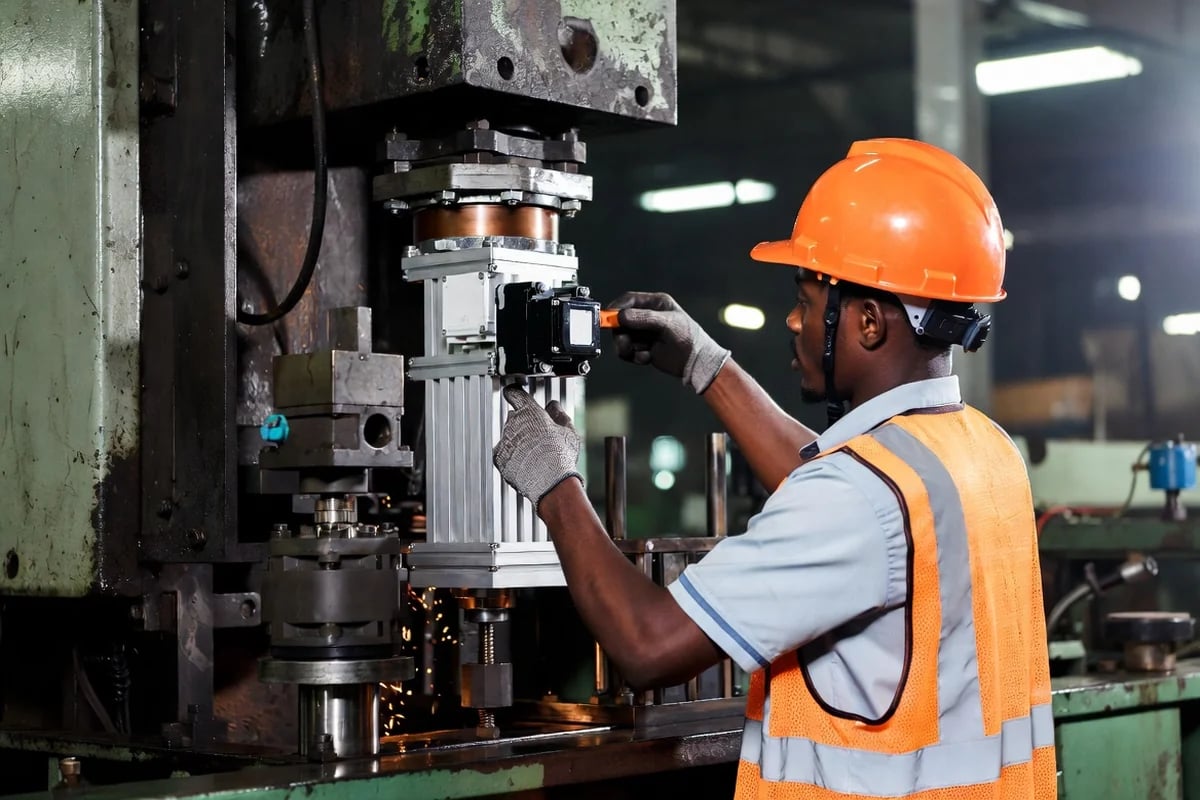
RoboFactory Africa approaches every retrofit engagement through a structured assessment phase before any engineering commitment is made. Specialist engineers conduct a full audit of existing control architecture, mechanical interfaces, and communications infrastructure — mapping what is present against what the client’s production objectives require. The result is a phased upgrade specification that sequences interventions by operational impact, allowing the facility to maintain throughput through each stage of the programme.
Where legacy systems carry salvageable mechanical integrity, the methodology preserves them and upgrades the intelligence layer: replacing legacy PLCs, introducing modern HMI environments, and integrating sensor networks that feed real-time process data to supervisory systems. Where mechanical components have reached the boundary of reliable service life, the specification is clear about replacement scope — never expanded beyond what the diagnostic evidence supports. Every engineering decision is documented, every configuration change is recorded in a formal handover register, and every operator is trained on the upgraded system before the project is closed.
The phased model is particularly suited to facilities in food processing, packaging, cement and aggregate, pharmaceuticals, and light manufacturing — sectors where continuous production is a commercial obligation, not a preference. RoboFactory Africa structures the engagement calendar around the client’s production schedule, not the other way around.
System Specification Framework
- Control Architecture Assessment — PLC generation mapping, I/O inventory, and communications protocol audit against target automation standard
- HMI Modernisation — replacement or overlay of operator interface environments with contemporary supervisory platforms suited to the facility’s operator profile
- Sensor Integration — deployment of process sensors, position encoders, and safety monitoring hardware calibrated to the upgraded control environment
- Network Infrastructure — industrial Ethernet or fieldbus commissioning to support machine-to-machine and SCADA-layer connectivity
- Safety System Review — e-stop circuitry, interlock logic, and guarding assessment aligned to the upgraded operational envelope
- Handover Documentation — as-built control drawings, configuration backups, and structured operator training materials delivered at project close
Typical Project Profile
A representative retrofit engagement involves a processing or packaging facility operating across two to five production lines, with a project scope spanning detailed audit, phased engineering design, staged commissioning, and operator qualification. Timelines vary with facility complexity and production scheduling constraints, but most engagements are structured to deliver measurable improvement in control system reliability and process visibility within a defined number of production-compatible phases. Sectors served include food and beverage processing, pharmaceutical packaging, industrial mixing and compounding, and commodity bagging operations across Ghana and Togo.
Outcomes
- Reduced unplanned downtime through modernised control logic and improved fault diagnostics
- Enhanced process consistency and traceability via integrated sensor and supervisory data environments
- Extended productive service life of mechanically sound equipment through targeted intelligence-layer upgrades
- Operator competence built into the project deliverable — not treated as an afterthought
- A documented, auditable engineering record that supports future phase planning and regulatory review