Why Automotive and Assembly Operations Specify RoboFactory Africa
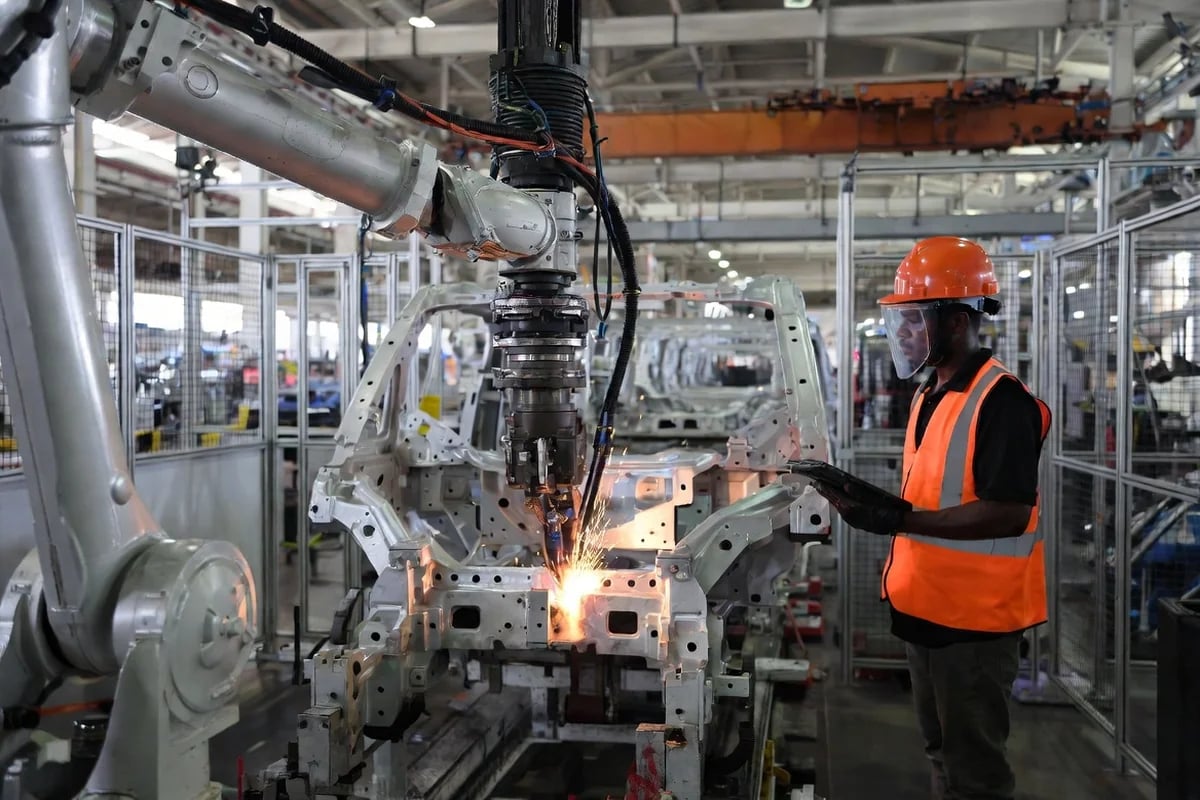
Automotive assembly and component manufacturing place demands on production systems that general-purpose machinery rarely satisfies. The precision tolerances inherent to drivetrain assemblies, body panels, wiring harness fitment and sub-component staging require automation architectures designed around repeatability — not approximation. RoboFactory Africa engineers automation systems specifically for these conditions, integrating robotic handling, conveyor sequencing, vision-guided positioning and process control into cohesive production lines that perform consistently across extended shifts.
Across Ghana and Togo, the growth of vehicle assembly operations — from knock-down kit assembly to localised component manufacturing — has created demand for integration specialists who understand both the mechanical requirements of the production floor and the operational pressures of throughput targets. RoboFactory Africa’s end-to-end engagement model — from initial consultation and engineering design through commissioning, operator training and ongoing support — means automotive clients receive a single accountable partner across every phase of their automation programme.
Specification Requirements Unique to Automotive and Assembly Operations
Automotive and assembly environments impose a distinct set of engineering constraints. Production lines must accommodate mixed-model sequencing, where the same line processes different configurations without manual retooling delays. Precision pick-and-place operations, torque-controlled fastening, adhesive dispensing and in-line quality inspection all require systems calibrated to tight repeatability windows. Safety integration — guarding logic, emergency-stop architecture and cobot-human collaborative zones — must be engineered to current industrial safety standards rather than retrofitted as an afterthought.
In the West African context, additional considerations include supply voltage stability, dust and humidity management within control enclosures, and the availability of local technical competence for first-response maintenance. RoboFactory Africa addresses these factors directly within the engineering specification phase, designing systems that perform reliably within the actual conditions of Ghanaian and Togolese industrial facilities — not idealised laboratory environments.
Recommended Services for Automotive and Assembly Operations
- Automation Consultation and Feasibility Engineering — structured assessment of production line throughput bottlenecks, manual process risk points and automation opportunity mapping
- Robotic Integration and Line Design — engineering and commissioning of robotic arms, end-effectors and collaborative robot cells configured for automotive assembly tasks
- Vision Systems and In-Line Quality Control — camera-guided inspection and measurement systems integrated directly into the production sequence
- Process Control and SCADA Integration — supervisory control architecture linking individual automation cells into a monitored, data-visible production system
- Operator and Maintenance Training — structured capability transfer programmes ensuring client teams can operate, troubleshoot and perform first-level maintenance on installed systems
Notable Project Types
RoboFactory Africa has engaged automotive and assembly sector clients on projects spanning the full range of production scales. Typical engagements include the automation of body panel sub-assembly lines at vehicle knock-down facilities, robotic wiring harness handling and routing cells, torque-verified fastening systems for powertrain assembly, and end-of-line functional test station integration. Phased automation programmes — where a facility transitions incrementally from manual to automated production across multiple project phases — are a common pattern, allowing clients to manage capital deployment and operational disruption in a structured sequence.
Larger-scale engagements have involved the design and integration of complete assembly line sections, coordinating robotic handling, conveyor transfer, station sequencing and quality gate inspection within a unified control architecture. In each case, the engineering scope is tailored to the specific production mix, facility layout and throughput objectives of the client operation — no two automotive engagements are configured identically.
Compliance and Standards
- Adherence to current international industrial robot safety standards governing guarding, collaborative operation zones and emergency-stop circuit design
- Electrical panel and control enclosure design aligned with applicable IEC standards for industrial environments
- Functional safety assessment integrated into automation design for human-robot interaction zones
- Systematic Factory Acceptance Testing (FAT) and Site Acceptance Testing (SAT) protocols prior to handover
- Documented operator training records and maintenance procedure manuals provided at project completion
- Ongoing support agreements structured to maintain system performance within specified operational parameters
Automation for Automotive & Assembly
RoboFactory Africa is an industrial and factory automation integrator — not a consumer-robotics, robotics-education or RPA-software vendor. For automotive and assembly operations that means physical automation on the line: robotic handling, vision-guided positioning, torque-controlled fastening and conveyor sequencing engineered for repeatability across extended shifts. The relevant capabilities sit across these services:
- Industrial Automation & Systems Integration — one accountable integrator from design to commissioning
- Robotic Installation & Integration — robotic arms, end-effectors and collaborative cells for assembly tasks
- Process Automation — station sequencing and process control engineered to the production mix
- Controls & Instrumentation — panels, PLC/SCADA, vision and in-line inspection instrumentation
- Automation Retrofits & Upgrades — reconfiguring existing manual or pneumatic lines to precise electric control
Engineered to Standard
We engineer to recognised practice — IEC 61131-3 (PLC programming), ISO 10218-2 / ISO 12100 (robot-cell and machinery safety risk assessment), IEC 60204-1 and IEC 62061 (machinery and functional safety for human-robot zones) and IEC 61439 (control-panel assemblies) — and within Ghana’s factory-safety regime, the Factories, Offices and Shops Act 1970 (Act 328) / DFI. We describe these as the framework we work to, and claim a specific certification or OEM-partner badge only where it is actually held.
Related Services
- Industrial Automation & Systems Integration
- Robotic Installation & Integration
- Process Automation
- Controls & Instrumentation
- Automation Retrofits & Upgrades
Request a consultation — or scope an automation project: +233 20 531 3333.