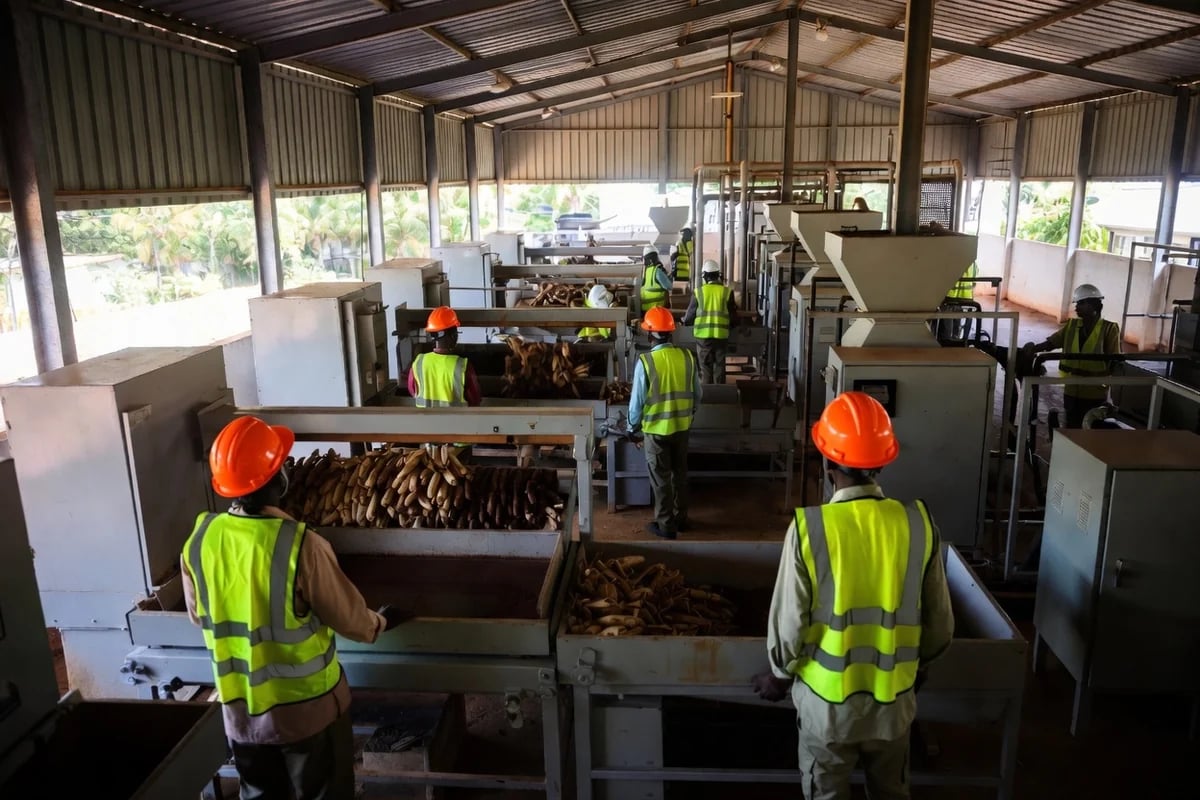
Why Agro-Processing Operations Specify RoboFactory Africa
Agro-processing sits at the intersection of biological variability and industrial precision — a combination that demands automation engineered specifically for the conditions it will meet. Commodity flows in Ghana and Togo carry seasonal peaks, variable input moisture levels, and product profiles that differ materially from those assumed by off-the-shelf European or Asian automation platforms. RoboFactory Africa designs for the actual operational environment: the humidity profile of a coastal processing shed, the throughput rhythms of a palm oil campaign season, the dust and particulate loads of a grain handling line in the northern production corridor.
The case for end-to-end automation in agro-processing is, ultimately, a case for consistency. Manual handling at critical points introduces contamination risk, measurement variance, and throughput ceilings that constrain a facility’s ability to scale. When automation is engineered phase by phase — beginning at primary processing and extending through grading, portioning, packaging and dispatch — the facility gains not only efficiency but documentary traceability: every batch measured, logged and recoverable for quality review or export compliance.
Specification Requirements Unique to Agro-Processing
Agro-processing automation in Ghana and Togo must be specified against conditions that are categorically more demanding than dry industrial environments. Washdown-rated enclosures, corrosion-resistant drive components and food-contact-appropriate conveying surfaces are baseline requirements, not optional upgrades. Control panel ingress protection ratings must account for high-humidity internal environments, and sensor selection must tolerate the aerosols and organic particulate that accompany primary processing of palm fruit, cassava, cereals and seafood.
Beyond the mechanical specification, the regulatory dimension adds a layer of complexity. Export-oriented facilities must demonstrate process controls aligned with international food safety frameworks, and documentation of those controls increasingly begins at the automation layer — in PLC logs, batch records and alarm histories. The automation architecture must therefore be specified not only for operational reliability but for auditability, with data outputs structured to support quality management processes from day one.
Recommended Services for Agro-Processing
- Process Consultation and Automation Feasibility — baseline review of current production flow, identification of highest-yield automation intervention points, and phased roadmap development
- PLC and SCADA Integration — programmable logic control and supervisory data acquisition configured for agro-processing batch and continuous-flow operations
- Conveying, Sorting and Grading Line Engineering — custom-specified material handling, optical or weight-based grading, and reject management integrated into the primary processing sequence
- Packaging Line Automation — fill-and-seal, portion control, labelling and case-packing systems adapted to local pack formats and production volumes
- Operator Training and Handover — structured knowledge transfer to facility teams, covering system operation, routine maintenance protocols and fault diagnostics
Notable Project Types
Typical engagements in this sector begin at the raw material reception point and progress through primary conversion — pressing, milling, drying or sorting — before connecting to secondary processing and final packaging. A palm oil processing facility in the Ghanaian south, for example, presents a different automation brief from a cassava starch facility in the Volta region or a maize milling operation supplying institutional buyers in Lomé: each has distinct hygiene zones, throughput rates and packaging requirements. RoboFactory Africa scopes each project individually, phasing investment to match the client’s capital cycle and operational readiness.
Larger projects typically combine SCADA-layer oversight with line-level PLC control, allowing operations managers to monitor yield, downtime and batch performance from a central interface. Smaller facilities often begin with a single automated line — grading or packaging — and extend the scope as operational confidence grows. Both models are supported through the same end-to-end methodology: consultation, engineering, commissioning and ongoing technical support.
Compliance and Standards Orientation
- Washdown and food-contact material compliance for all process-contiguous components
- Ingress protection ratings appropriate to high-humidity and particulate-dense environments
- Batch traceability architecture supporting internal quality management and export documentation
- Electrical installation and panel build aligned with recognised IEC practice (e.g. IEC 61439 for control panels) and Ghana’s Factories, Offices and Shops Act 1970 (Act 328) / DFI safety regime
- Control system documentation and as-built records maintained for ongoing regulatory audit support
- Operator competency verification protocols delivered as part of standard project handover
Automation for Agro-Processing
RoboFactory Africa is an industrial & factory automation integrator — physical automation engineered for the actual operating environment, from primary processing through packaging and dispatch. This is not consumer robotics, robotics education, or RPA software. The services that typically carry an agro-processing engagement:
- Industrial Automation & Systems Integration — one accountable team, design to commissioning
- Process Automation — pressing, milling, drying, sorting and packaging lines automated to the target
- Automation System Design & Engineering — control architecture for washdown and high-humidity conditions
- Controls & Instrumentation — IP-rated panels, PLC/SCADA, sensors for particulate-dense environments
- Robotic Installation & Integration — grading, case-packing and palletizing cells
Engineered to Standard
We engineer to recognised practice — IEC 61131-3 (PLC programming), IEC 61439 (control panels), ISO 12100 / ISO 10218-2 (machinery & robot-cell safety) — with washdown-rated, food-contact-appropriate hardware and batch-traceability logic specified from the outset, within Ghana’s Factories Act 328 / DFI safety regime. We describe these as the framework we work to, and claim a specific certification only where it is actually held. We serve agro-processors across Ghana’s production corridors and Tema, into Togo (Lomé) and the wider West-African market.
Every engagement is scoped and quoted per project — product profile, line scope, seasonal throughput and new-build vs retrofit all drive it. We quote against your actual requirement, never an invented figure.
Request a consultation — or scope an automation project: +233 20 531 3333 (Togo / Francophone: +228 96 86 86 75).