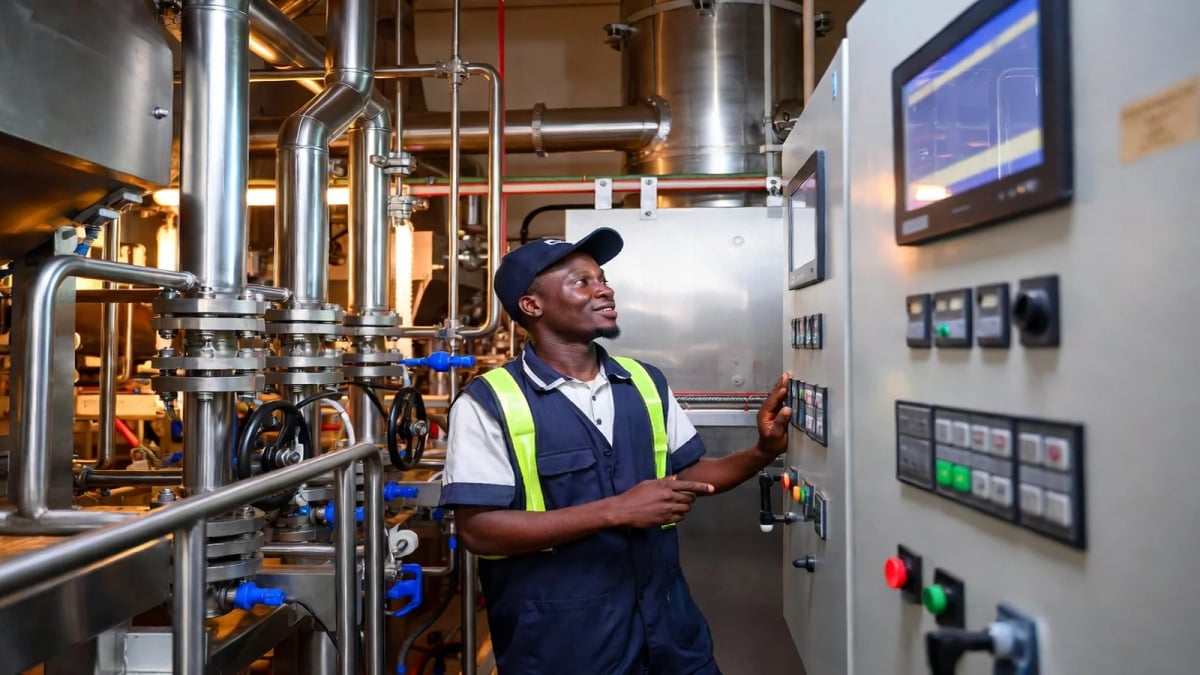
Process automation for a food processing line
A food processing operation required automated process control across its production line to improve output consistency. The Project Office designed and commissioned a controls and instrumentation solution, followed by structured operator training.
Project Profile
Sector: Food processing — ambient and chilled product lines Scope: End-to-end automation of a multi-stage processing line, from raw input handling through packaging and palletisation Engagement Phases: Consultation and process audit → engineering design → phased integration → operator training → ongoing support Location: Industrial corridor — Greater Accra Region, Ghana
A mid-to-large-scale food processing operation engaged RoboFactory Africa to transform a predominantly manual production line into a structured, automated system capable of meeting the output consistency and food-safety requirements of formal retail and export channels.
The Specification Challenge
The facility had grown organically over several operational cycles, resulting in a production floor where manual handling, inconsistent throughput, and variable product quality were embedded into the line’s structure rather than its edges. Bottlenecks were not isolated — they were systemic.
Three compounding factors defined the complexity of this engagement:
- Food-grade compliance requirements: Automation hardware, sensors, and conveyance systems needed to meet food-safe specifications across wet and dry zones, with hygienic design principles applied consistently.
- Zero-halt production pressure: The client operated without the luxury of a full production shutdown. Any integration work had to be structured around rolling operational windows, protecting revenue continuity throughout the transition.
- Mixed-skill workforce: Operator familiarity with automated systems was limited. The solution had to be engineered not only for performance but for human operability — with clear interface logic and training built into the delivery model from the outset.
Approach
RoboFactory Africa structured the engagement in defined phases, each validated before the next was initiated.
The process audit stage mapped every stage of the existing line — identifying the specific transition points where automation would deliver the highest operational return and where sequencing logic needed to be redesigned before hardware was introduced.
Engineering design translated the audit findings into an integrated system specification: conveyance, process control, sensor arrays, and human-machine interface logic designed as a unified architecture rather than a collection of independent upgrades.
Phased integration allowed production to continue through the deployment period. Critical line segments were brought into automation sequentially, with parallel manual fallback maintained until each automated segment was validated under live conditions.
Operator training was delivered on-site, in the client’s working language, across multiple shift groups — ensuring that the transition from manual to automated practice was embedded in the workforce, not merely documented in a manual.
Outcome
Following full integration across all production phases:
- Throughput consistency across shift cycles improved substantially, reducing the variability that had previously made formal supply commitments difficult to honour
- Product waste at the handling and packaging stages dropped to a materially lower level than baseline
- The facility’s food-safety posture strengthened, supporting the client’s qualification pathway for formal retail and regional export accounts
- Operator confidence and system uptime within the first production quarter exceeded the benchmarks set at the engineering design stage
What This Project Demonstrates
Food processing operations across Ghana face a common structural constraint: production infrastructure that was built for smaller volumes and manual throughput, now asked to perform at a scale and consistency that only automation can reliably deliver.
This engagement demonstrates that the transition is achievable — not through a disruptive replacement of the entire floor, but through disciplined phased integration, engineering precision, and training that makes the technology work in the hands of the actual workforce.
For food processors operating in Ghana and Togo considering formalisation, export qualification, or capacity scaling, this project represents the standard of engagement RoboFactory Africa brings to every commission.