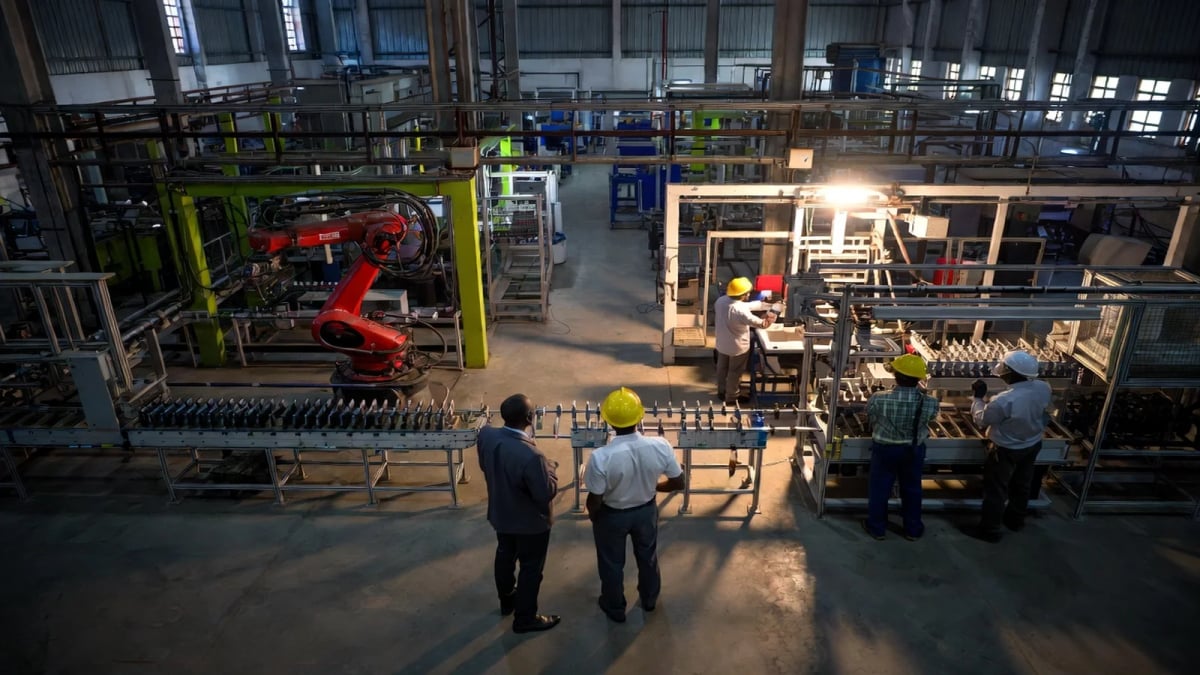
Phase-by-phase automation for a manufacturing plant
A manufacturing operation sought to reduce manual-handling dependency across its production floor. The Project Office conducted a full assessment, designed a phased automation programme and installed integrated robotic systems to the first phase specification.
Project Profile
Sector: Fast-moving consumer goods manufacturing Scope: Full-cycle automation engagement — process audit, engineering design, phased integration, operator training and post-commissioning support Geography: Greater Accra Industrial Zone, Ghana Timeline: Multi-phase programme delivered across three consecutive production quarters
A mid-scale FMCG manufacturer operating within Ghana’s Greater Accra Industrial Zone had reached the ceiling of what manual production lines could sustain. Volume targets were outpacing operator throughput, quality consistency was deteriorating across shifts, and downtime events were compounding into measurable revenue loss. The business required a structured transition from manual-intensive production to a reliable, integrated automated process — without halting active manufacturing operations.
The Specification Challenge
The complexity of this engagement was not merely technical — it was operational. The facility remained in active production throughout the integration programme, which meant every phase of the automation work had to be sequenced around live shift schedules, raw material flows and delivery commitments.
Three additional pressures shaped the specification:
- Heterogeneous equipment: Existing machinery from multiple generations and manufacturers required integration into a unified control architecture, rather than wholesale replacement.
- Operator transition risk: A workforce accustomed to manual process rhythms needed to be brought alongside the new systems without loss of morale, productivity or safety compliance.
- Scalability requirement: The client’s growth projections demanded that the automation architecture be designed for future-phase expansion — not simply optimised for current throughput.
Any approach that treated this as a standard equipment-installation exercise would have failed within the first phase.
Approach
RoboFactory Africa deployed a phased engagement model structured around four disciplines:
1. Process Consultation and Audit A detailed operational audit mapped existing line performance, bottleneck nodes, downtime patterns and quality-failure points. This formed the engineering specification baseline — ensuring every subsequent decision was anchored to actual facility data rather than generic assumptions.
2. Engineering and System Design Control architecture, sensor integration, conveyor sequencing and supervisory logic were designed to interface with retained legacy machinery. A unified SCADA-compatible layer was specified to give production supervisors consolidated visibility across all line stages.
3. Phased Integration Automation was introduced line-segment by line-segment, allowing production to continue on unaffected sections while each new module was commissioned, tested and stabilised before the next phase commenced.
4. Operator Training and Ongoing Support Training was delivered in two stages — system familiarisation ahead of each phase go-live, followed by advanced operational training post-stabilisation. A structured support retainer was established to cover remote monitoring, rapid-response intervention and periodic system review.
Outcome
By the close of the final phase, the facility had transitioned from predominantly manual throughput to a majority-automated production environment. Downtime events decreased substantially. Cross-shift quality variance — previously a persistent compliance concern — was brought within a controlled tolerance band. Supervisory visibility improved markedly, with production data accessible in real time rather than reconstructed post-shift from paper logs.
The operator workforce completed the transition with measurably higher engagement scores than baseline — a direct result of the phased, training-inclusive methodology.
What This Project Demonstrates
Across Ghana’s manufacturing sector, the most demanding automation engagements are those that must be delivered into live, revenue-generating facilities — not greenfield builds. Phase-by-phase integration, grounded in a rigorous process audit and supported by structured operator development, is the model that protects both production continuity and long-term system performance. This is the pattern RoboFactory Africa is engineered to execute.