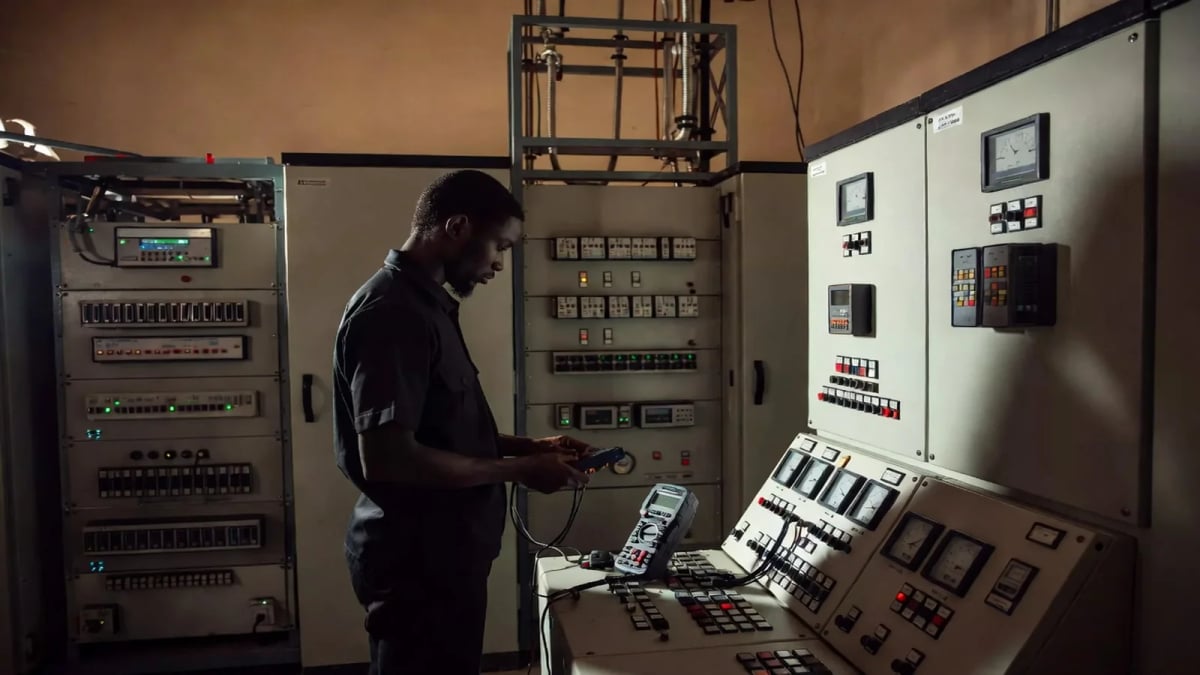
Controls and instrumentation retrofit for a mining operation
A mining operation required a controls and instrumentation retrofit to replace ageing systems and improve process reliability. The Project Office delivered the upgrade in planned phases with structured handover and ongoing maintenance support.
Project Profile
Sector: Mining and mineral processing — mid-scale open-pit and primary processing operation Scope: Full controls and instrumentation retrofit across primary processing circuits, including legacy PLC migration, field instrument replacement, and SCADA integration Location: Northern Ghana mineral processing corridor Timeline: Phased execution across two operational quarters, designed to avoid extended production downtime
The operation had run its original control architecture for well over a decade. Equipment that had once been adequate was now a structural liability — limiting throughput visibility, generating unreliable process data, and creating hazardous gaps in safety interlock coverage.
The Specification Challenge
Mining environments impose demands that standard industrial retrofit programmes are not designed to absorb. Dust ingress, vibration loading, temperature cycling, and the corrosive character of mineral slurry all accelerate degradation in field instruments and control panel hardware.
The additional complexity here was operational continuity. The client could not sustain a full production shutdown. Any retrofit programme had to be sequenced around live circuits — replacing instrumentation zones progressively while maintaining process throughput on adjacent lines.
The legacy PLC platform was obsolete: no vendor support, no available firmware updates, and a communication protocol incompatible with any modern SCADA layer. Engineering had to bridge the old system into a live parallel configuration before cutover — a technically demanding transition that left no tolerance for sequencing errors.
Approach
The engagement opened with a full instrumentation audit across every field device, junction box, cable run, and control panel. Findings were mapped against the client’s process flow documentation to establish criticality tiers — determining which circuits were safety-critical, which were production-critical, and which could be sequenced later in the programme.
Engineering then developed a phased cutover plan built around the operation’s shift rotation. Each phase included a parallel-run window during which the new PLC tier operated alongside the legacy system before hard cutover. Field instruments — flow, level, pressure, and temperature — were replaced with industrial-grade devices specified for the site’s environmental classification.
SCADA integration was commissioned last, once field signal integrity had been validated across all circuits. Operator interface screens were configured to the production team’s workflow, minimising retraining burden and reducing the risk of operator error during the transition period.
Structured handover training was delivered in-shift, ensuring the operations crew and maintenance team could manage the new architecture independently from day one of full live operation.
Outcome
The operation emerged from the programme with a unified, vendor-supported control architecture — readable, maintainable, and capable of providing the process visibility the previous system had never delivered. Instrumentation data became actionable in real time. Safety interlock integrity was fully restored and documented. Maintenance teams no longer needed to improvise around unsupported hardware.
Production continuity was preserved throughout. No unplanned shutdown occurred during the cutover sequence.
What This Project Demonstrates
Mining and mineral processing operations across Ghana frequently carry ageing control infrastructure that accumulated over successive expansions and budget cycles. The result is fragmented architecture: mismatched PLC generations, undocumented field wiring, and SCADA layers that reflect organisational history rather than operational logic.
A disciplined, phased retrofit — anchored in rigorous site audit and executed without production disruption — is both achievable and transformative. This project demonstrates that controls modernisation in live mining environments is an engineering discipline, not merely a procurement exercise. The discipline lies in sequencing, validation, and structured knowledge transfer: ensuring the operation retains full control of its new infrastructure long after the engagement closes.