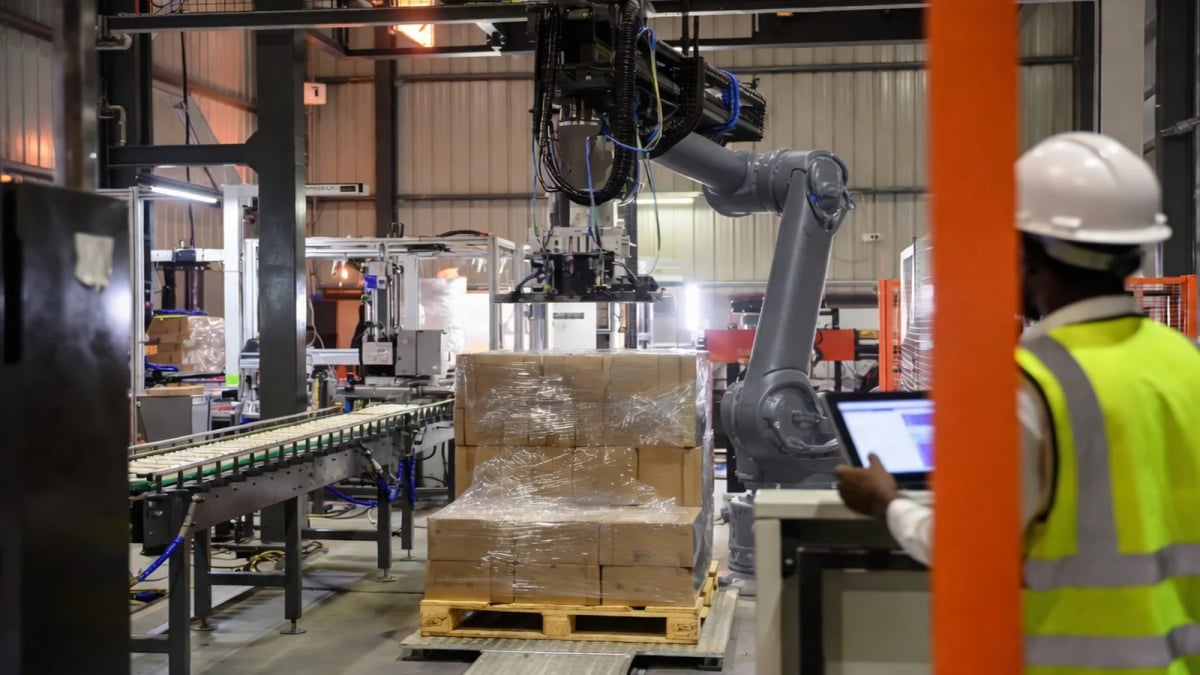
Robotic integration for a packaging operation
A packaging operation required robotic integration across its palletising and sealing stages. The Project Office installed and commissioned the robotic system, integrating it into the existing line with minimal production interruption.
Project Profile
Sector: Fast-moving consumer goods — secondary packaging Scope: End-to-end robotic integration across a multi-line packaging hall Geography: Greater Accra Industrial Corridor, Ghana Engagement Model: Phased delivery — consultation, systems engineering, integration, operator training, and ongoing support
A leading FMCG manufacturer operating across the Greater Accra industrial corridor approached RoboFactory Africa with a clear mandate: eliminate the throughput ceiling imposed by a fully manual secondary packaging operation and build a platform capable of scaling with increasing production volumes. The facility ran three packaging lines simultaneously, each dependent on manual labour for case erection, product loading, carton sealing, and palletisation.
The Specification Challenge
Manual secondary packaging at this scale carried compounding operational risks. Line stoppages caused by fatigue, inconsistent pack integrity, and variable palletisation patterns were creating downstream losses at the distribution stage. Critically, the client required integration that would not necessitate a full production shutdown — changeover had to occur in phases, with live lines remaining operational throughout.
The control architecture presented a further challenge. Legacy conveying equipment from multiple vendors operated on incompatible communication protocols, requiring the integration layer to act as a universal translation environment before any robotic cell could be introduced.
Production scheduling also demanded that the robotic cells handle multiple SKU formats — varying case dimensions and weight profiles — across the same line, without extended retooling windows between runs.
Approach
RoboFactory Africa deployed its phased integration methodology across three stages.
The engagement opened with a structured consultation period: process mapping across all three lines, cycle time analysis, and identification of the communication architecture required to bridge legacy conveyor systems with the incoming robotic control layer.
In the engineering phase, a unified supervisory control framework was designed — one capable of managing robotic cells, existing conveyor infrastructure, and line sensors through a single operator interface. This eliminated the protocol fragmentation that had constrained any prior automation attempts.
Robotic cells were then commissioned line by line, allowing the facility to maintain output while integration progressed. Case erection, product loading, and palletisation were automated sequentially. Each cell was programmed to handle the client’s full SKU range through parameter-driven changeover, reducing format switchover to a matter of minutes.
Operator training ran in parallel with commissioning. The programme was structured to build genuine system fluency — not surface-level panel familiarity — so that the internal maintenance team could manage routine calibration and minor fault resolution independently.
Outcome
At the conclusion of the final phase, all three packaging lines operated under a unified robotic and supervisory control architecture. Throughput consistency improved materially across all lines, with palletisation quality reaching a standard that reduced distribution-stage pack failures to a negligible rate. The internal team demonstrated full operational confidence at system handover, reducing dependency on external technical intervention for day-to-day operation.
What This Project Demonstrates
Secondary packaging in Ghana’s FMCG sector is undergoing a structural transition — from labour-intensive manual operations toward robotic systems that can absorb volume growth without proportional headcount increases. This engagement illustrates the technical and logistical demands that transition carries: protocol fragmentation, live-line changeover constraints, and SKU variability are the rule, not the exception.
Phased integration, designed from the outset around the client’s specific control environment and production scheduling reality, is the architecture that makes this transition operationally viable. It is the model RoboFactory Africa brings to every engagement of this type.