The problem
Institutional buyers need a documented, HSE-disciplined source for training & enablement.
Our approach
Training & Enablement
Training & Enablement delivered to institutional standard — structured procurement, chain-of-custody discipline, documented handover.
The Challenge
Factory automation delivers its full value only when the operators, technicians, and shift supervisors who interface with it daily possess the knowledge to run, troubleshoot, and sustain it with confidence. Across manufacturing and processing facilities in Ghana and Togo, a familiar pattern emerges: sophisticated automated systems are commissioned to specification, yet productivity targets remain elusive because the human layer has not been brought to the same standard as the mechanical and electrical layer. Capability gaps compound over time — workarounds become habits, alarms are silenced rather than resolved, and the operational life of precision equipment shortens accordingly.
The challenge is structural, not incidental. Industrial training programmes designed for other regions rarely translate cleanly to the Ghana and Togo operating context, where shift structures, maintenance resourcing, and spare-parts logistics carry their own specific character. Generic vendor training — delivered once at commissioning and never reinforced — cannot build the institutional competency that complex automated lines require. What facilities need is a structured enablement programme anchored to their actual equipment, their actual processes, and their actual workforce.
The RoboFactory Africa Solution
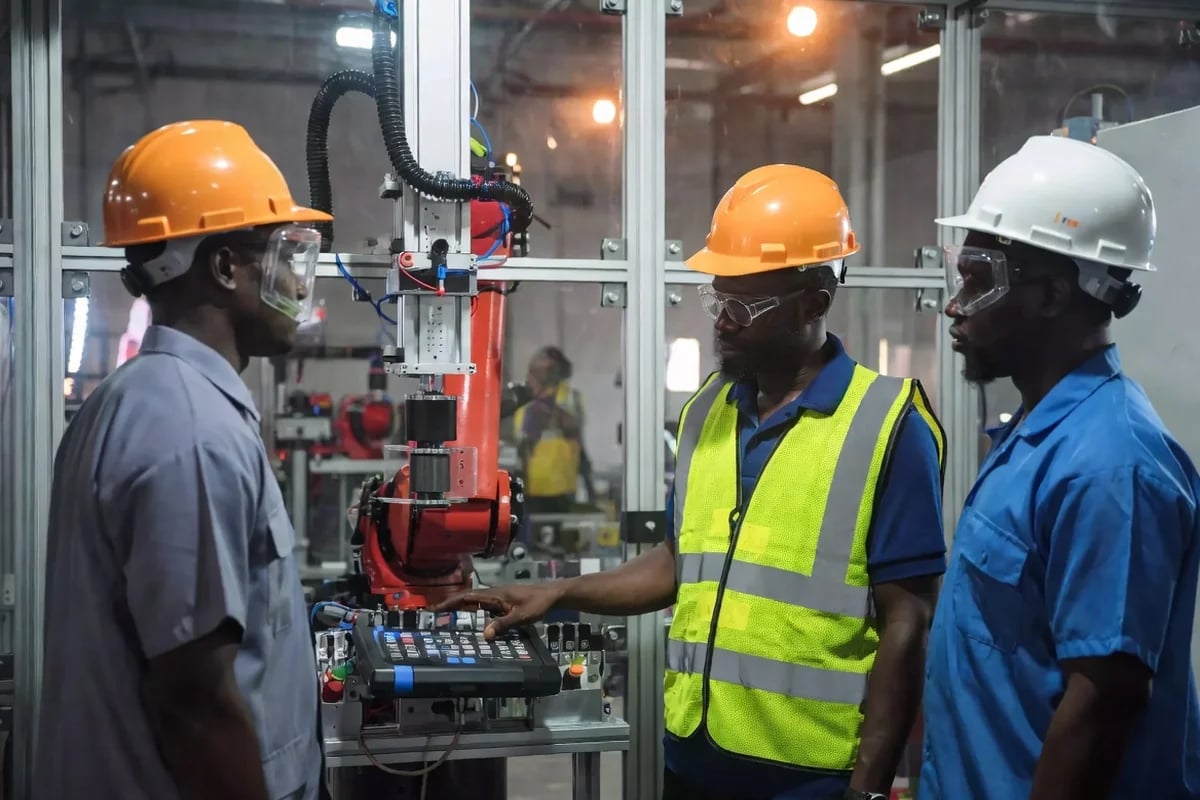
RoboFactory Africa approaches Training and Enablement as an engineered deliverable in its own right — not a post-commissioning courtesy. Every programme begins with a structured competency mapping exercise: the team works with the client’s operations management to define the roles that interface with the automated system, the tasks each role must be able to perform independently, and the fault scenarios each must be equipped to manage. From that baseline, a curriculum is designed at the intersection of the client’s system architecture and their workforce’s existing technical foundation.
Delivery is structured across defined phases — foundational systems orientation, hands-on operational practice, fault diagnosis and response protocols, and preventive maintenance routines — with assessment checkpoints at each stage. Training is conducted on the client’s live or pilot-equivalent equipment, using documentation sets that remain with the facility as permanent reference material. Sessions are available in English and French, reflecting the operating environment across Ghana and Togo. Where shift coverage requires multiple cohort runs, the programme is structured accordingly, ensuring no role-group is left without coverage.
Programme Specification
- Competency-mapped curriculum — programme scope defined against specific job roles, machine interfaces, and operational scenarios, not generic module templates
- Phased delivery structure — foundational orientation, operational practice, fault-response protocols, and preventive maintenance covered in sequence with checkpoint assessments
- Bilingual delivery — programmes available in English and French to serve mixed-language operational teams across Ghana and Togo
- Permanent client documentation — structured operator manuals, maintenance schedules, and quick-reference materials handed over as facility-owned assets at programme close
- Live-equipment or pilot-equivalent training — all practical sessions conducted on the client’s actual installed system or a representative equivalent, not simulated environments
- Multi-cohort scheduling — programme structured for shift-based workforces where full-facility coverage requires sequenced cohort delivery
Typical Project Profile
A representative engagement covers a mid-scale processing or manufacturing facility in Ghana or Togo that has recently completed an automation phase or is preparing to bring a new line into production. The programme typically spans two to four weeks of structured delivery across multiple cohorts, covering operator-level, technician-level, and supervisory roles on a single automated system or integrated production line. Sectors served include food and beverage processing, pharmaceutical manufacturing, consumer goods production, and light industrial assembly — any operation where process automation is central to throughput and quality control.
Outcomes
- Reduced fault-to-recovery intervals — trained technicians identify and respond to system events using documented protocols rather than improvised diagnostics
- Lower unplanned downtime — operators equipped with correct run-procedure knowledge sustain consistent line performance across shifts
- Sustained institutional knowledge — documented training materials and assessment records remain with the facility, protecting competency continuity through staff transitions
- Increased operational confidence — supervisory and technical staff engage with the automated system as a managed asset, not an opaque dependency
- Stronger return on automation investment — enablement closes the gap between system capability and operational yield, realising the full value of the automation phase